
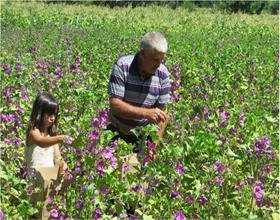
The harvesting of medicinal plants (threshing, mowing, extracting) is carried out at the stage of technological ripening when parts of the plants contain the most active matter and when they are in the most suitable ratio to each other.
There are several rules according to which harvesting is carried out:
- The flower is harvested at the time of full blooming
- The leaves are harvested at the pre-flowering stage
- The herb (above-ground part) of the plant is mowed at the beginning of flowering
- The fruits are harvested at the stage before full ripeness
- The root is pulled out at the end of the growing season (in autumn) or in spring before the start of the growing season.
Harvesting can be done by hand or by machines. Hand harvesting is characteristic for small areas and specific conditions, whereas mechanized harvesting is applied to larger areas. Fresh harvested plant material has a limited shelf life and therefore needs to undergo canning. Preservation can be done in several ways, but drying is the most common and simplest form of preservation.
Drying removes excess moisture from parts of plants; drying fresh plant material is the fundamental process for maintaining the desired quality of medicinal plants as a prevention against the development and growth of microorganisms in the stored plant material. Drying results in a reduction of the mass of dried plants relative to the fresh plant matter.
The ratio of fresh plant mass to dried material is understood to be different among different types of plants and their parts.
Plant cells contain 60-95% free water, and the presence of water in such a high percentage is often the main cause of spoilage of fresh plant material. During the drying process, dried plant parts are obtained from the fresh plant material.
The dried plant part means the dried flower, dried leaf, dried above-ground part (herba), dried root, or regardless of which part of the plant it is.
The amount of water in the dried part of the plant is around 10%. In some dried parts of the plant, a lower water content of about 5-6% is required. The moisture contained in the dried parts of the plant, that is, the moisture remaining from the material after drying, is called primary moisture. Due to irregular deposition, it happens that the dried part of the plant quickly absorbs atmospheric moisture, which can then lead to its decay and destruction.
This moisture is called secondary, and its effect is prevented by properly packaging the dried brine parts.
Drying technology is extremely important because, thanks to it, among other things, a good appearance and quality are ensured in the dried parts of the plants, which from a commercial perspective is extremely important. Irregular drying results in low-quality dried plant parts in terms of the amount of active substances in the plant material and in terms of organoleptic characteristics (appearance).
The drying temperature depends on a large number of factors, among the most important being the plant part that dries out and the type of active substances it contains.
Soft plant organs (flowers), which contain components that evaporate easily, are dried at temperatures from 35 - 40°C, while for drying the harsher parts of plants, the necessary temperatures (roots) are from 50-60°C. Plants rich in alkaloids, tannins, etc., can be dried at temperatures from 60 - 70°C without losing active substances. Plant species that contain a higher amount of vitamins, especially carotids, are dried at temperatures up to 80°C. Drying can be: natural or artificial.
Natural drying is the process of drying plant material without the use of artificial energy sources and is carried out under natural conditions. It means drying in a thin layer, not compacted on a suitable base (planks, boards) in the shade and in places with a surface (air current). The most suitable spaces for this drying method are: garages, ceilings, courtyards, hangars, and similar places. It is very important that in the spaces designated for drying, a continuous airflow is ensured, which increases the quality of drying. This drying method is applied to flowers, leaves, and herbs.

The mentioned plant parts are not finely ground before drying but are dried as a whole. During the drying process, frequent rotations and mixing of the dried material should be avoided in order to prevent breakage and fineness. If the plant material is placed in the dryer in a thick layer, fermentation often occurs rather than drying, meaning the dried plant parts deteriorate. The duration of drying depends on weather conditions because fresh plant material dries best in sunny weather, with dry air currents, rather than when it rains or there is fog. It also depends on the season; in summer they dry faster, while in autumn and spring they dry more slowly. Natural drying can also be done so that the plant material is exposed to direct sunlight. This type of drying is characteristic for drying bark, roots, and seeds. Before exposure to sunlight, the bark and roots are cut into small pieces so they dry faster. Leaves and flowers dry for 3-5 days, rarely up to 8 days, while roots dry up to 15 days.
Small quantities of medicinal plants are dried in such a way that they are tied into rows which are then tied and placed under a shelter, in garages, or in yards. This natural drying method gives dried plant parts good quality and is one of the first ways to dry medicinal plants, once the only drying option.
The absence of this drying method requires sufficient space, while the quality of drying and the time needed for the plant material to dry sufficiently depend on weather conditions (clouds, rain, sun, wind).
Artificial drying is carried out in specially constructed facilities known as dryers. The impact of climatic conditions on the drying process is minimized, and it is also possible to regulate drying temperature, relative humidity, and air circulation. In this way, drying time is reduced by several days to several hours.
There is also drying with warm air at a temperature of 200 to 1000°C, where the drying process lasts 2-5 minutes. Dryers are used for drying different types of plants (trees, mushrooms, vegetables, tobacco) but with limited adaptability, they can also be adapted for drying medicinal plants. This is achieved by decreasing or increasing the working temperature (adjusting the heat regime), speeding up or decreasing the moving strips, changing the lenses with smaller or larger openings, and similar methods.
For organic production, it is especially suitable that dryers be made from non-corrosive material, that is, from materials permitted for use in organic production.
There are several types of dryers: Non-removable dryers are built where there is enough plant material that needs to be dried. They are built on the floor and in tunnel form. In those with floors, warm air flows through the perforated base, passes through the fresh plant mass, and thus performs the drying process. The tunnels are made with movable belts or carts, with a very large capacity and very good drying quality.
Mobile dryers have a smaller capacity. They provide good quality of the drug. Their advantage is that they can be easily transported from one place to another in the field where there is more drying material, thus avoiding the transport of large quantities of fresh plant material. These dryers are of the trolley tunnel type (1, 2, or 3 trolley aisles) in which a certain number of trolleys are placed (most often 15-20 skewers per cart). The surface area of one skewer is usually 1m²; these dryers are suitable for maneuvering, and their advantage is that they can easily switch to using other energy. This option is very important in fields where there are solid fuels (wood, plant debris), because the boiler is easily replaced and expensive oil and electricity are easily replaced with cheaper solid fuels.
Tunnel-type greenhouses covered with black foil can also be used for drying. This greenhouse has an area of 50 m² (length 10 m, width 5 m, and height 2 m). Side openings for ventilation on both sides are also left inside the greenhouse. Inside the greenhouse, shelves are placed to place drying materials: plants, leaves, flowers, etc. The black plastic coil absorbs heat as an energy source – solar radiation. So this is a very suitable way to utilize alternative energy – solar energy. If plants are dried this way, the dried plant parts and roots will retain their good color.
Dried plant parts are packed in a designated container and, once packaged, are stored until further processing or delivery to the consumer. The type of packaging depends on the type of dried plant part, its quantity, the method of transportation, and possibly the buyer's specific requirements. Dried briming parts are most often packed in paper bags, cardboard boxes, burrs, and wooden sandbags.
Keep in mind: The use of PVC packaging in organic plant production is not allowed.
Light-sensitive dried plant parts are packed in cardboard boxes lined inside with dark paper (p.sh chamomile flowers), saffron in non-corrosive metal boxes, etc. It is important to emphasize that during packaging filling, dried plant parts must not be pressurized to avoid being finely crushed; they should be chopped, as this will cause quality loss. Packaging must be done carefully so that the worker handles the dried plant parts only once without any load. The packaged dried plant parts are deposited and kept in specially constructed warehouses. The storage must be dry and clean, and it is essential to ensure good continuous air circulation. It must be well sealed and protected from the possibility of entry by insects, mice, and birds. It is necessary to protect it from direct sunlight, which in some types of dried plant parts causes the loss of natural color and thus also reduces quality and poor appearance (organoleptics). Pallets or wooden shelves should be placed in the storage so that the stored dried plant parts should be lifted from the floor and removed from the walls and ceiling.
The storage must also be secured from the aspect of fire protection (marking fire routes with the direction of movement, installing hydrants, and placing fire extinguishers in a visible location).
Inside the warehouse, it is essential to ensure relative air humidity of less than 60% and a temperature not exceeding 25°C, because these are the parameters that enable the best conditions for storing the stored medicinal plants. Dried plant parts sent to the warehouse for disposal must have accompanying documents containing all necessary data (name of the dried plant part, origin, date of entry into the warehouse, analysis data). Additionally, some rules must be followed during storage: Dried plant parts must be removed from the warehouse in the order of entry, the storage must not be higher than 2 meters, dried poisonous plant parts are stored in separate spaces and are especially labeled, and the dried plant parts with strong odor are separated from the others so that the other dried plant parts do not absorb their odor. Red labels mark dried brimmy parts that have failed quality control and are stored separately; yellow labels indicate those currently under inspection; green labels indicate those that can already be used.
Dried plant parts will be subject to spoilage, regardless of the drying method, the type of packaging in which they are packed, or the method of storage. The more intense the spoilage is, the longer the dried plant parts are stored, and the causes can be present in considerable numbers. Moisture, heat, light, living organisms, oxygen, and various odors. Natural preparations also destroy harmful insects in the warehouse, always in accordance with the principles of organic production of medicinal plants.
The storage period of dried plant parts that do not affect their quality is specific and varies significantly from plant to plant, as well as from organ to organ within the same plant species. The longest possible shelf life for some dried plant parts is as follows: elderflower flower – 1 year, nettle leaf, chamomile flower, elderberry flower – 3 years, various barks – 6 years, while roots of some plants up to 10 years. See the table below, tables 1 and 2.
STABILITY OF MEDICINAL PLANTS IN STORAGE
|
Medicinal plant |
In-Storage Durability |
|
holly flower |
1 year |
|
Hithid leaf |
2 years |
|
chamomile flower |
2 years |
|
elderflower |
3 years |
|
various peels |
6 years |
|
the root of some plants |
10 years |
Available in: SHQ, ENG, SRB