
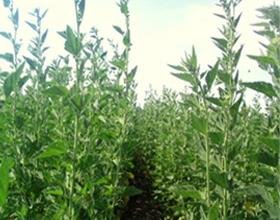
WHITE MULLET (ALTHEA OFFICINALIS L.)
For sale, the following are encountered:
White mallow leaf - Althaea folium
White mallow flower – Althaea phlos
The root of the white cinquefoil – Althaea radix
White mallow can be found near large rivers, in wet meadows, and near roads as a wild plant. Due to the increasing demand for white mallow in recent years, besides its natural growing mildew, organized cultivation of this plant has also begun. In cultivated mallow plants, the root is fuller, thicker with a lot of mucus, than the roots of wild plants.
Morphological and physiological characteristics
White mallow is a perennial plant with a strong root system. Its roots are branched, fleshy, pale brown on the outside, and white inside. From the root head emerge stalks that reach heights from 1.5 up to 2 meters.
See photo

Chemical composition and use of white mallow
Since ancient times, white mallow has been known as a folk remedy. In our country, it is used both in folk medicine and scientific science. The root is mostly used and is used to heal the respiratory tract and against coughing. In addition, mallow is also used as a combination of various teas.
In the root of mallow, there is 30-35% mucus secretion, nearly 35% starch, something of sucrose, pectin, etc.
Cultivation conditions
Climate - it is a plant of the continental climate. It grows especially well in mild climates and is not sensitive to low temperatures during winter. It thrives best in areas where annual rainfall exceeds 600 mm.
Soil - For mallow cultivation, the right choice of soil is a good condition for success. The highest yields come from fresh alluvial transports in black soils with light mechanical content, as well as in all soils with good mechanical content. Therefore, it is desirable that groundwater be in the active root zone. Mallow should not be planted in heavy mechanical soils. The best yields are given in rich soils. For mallow planting, we can use soils that are periodically flooded. Mallow can remain underwater for 10-15 days without damage.
Cultivation
Crop rotation - White mallow remains in the same plot for 1 year, at most 2 years. It cannot tolerate monoculture and must be cultivated by rotating other crops. Crop rotation should be done in such a way that the same soil is cultivated after 3 - 4 years. It should be considered that the crop leaves behind loose and clean soil free of weeds. Raising the area with white mallow is best successful after fertilized crops, of course only with organic fertilizers.
Soil cultivation - has a strong and branched root system that penetrates deeply into the soil; the fundamental goal of cultivation is to create a deep loving layer in which the root system can develop without obstacles. The soil for white mallow must definitely be plowed in autumn, and as early as possible. The tilling depth depends on the soil type, but it should not be less than 30-40 cm. If mallow is planted immediately in autumn, the plot must be cultivated right after tillage. Whereas if planted in spring, the lovage remains in the open bed, and in spring before planting, surface cultivation is done.
Fertilization - It is not preferred that a plot planted with white mallow is directly fertilized with barn manure. It is only sufficient if the crop was previously fertilized with barn manure.
Propagation - There are several types of propagation of white mallow, but in practice, we encounter the following methods:
Direct planting through seed
Producing seedlings in cold leaves and then transplanting them.
Planting root head fragments from old plants
Direct sowing with seeds is done in late autumn, in November, or early December when there is no possibility for seeds to germinate in autumn. If this period is exceeded, sowing is done in spring towards the end of February. Regardless of whether we are dealing with autumn or winter-spring planting, the plot must be well prepared, and the soil should be well compacted. Seeds are planted with a seed drill at a distance of 50-70 cm in order. They are planted at a depth of 1-2 cm. For direct sowing of 1 ha, 3–4 kg of seed are used. Mallow seeds germinate slowly. In 4 weeks of active temperature, only 50–60% of the planted seed germinates. After germination, in the initial development phase, white mallow develops slowly, and for this reason, special care is necessary from the very first stage. This planting method is evident in plots that are not very rooted by perennial weeds; otherwise, the chances of success are slim.
Producing seedlings - in cold bark, and quickly transplanting them to a permanent location in an open field is expensive but the most reliable method of planting the white mallow crop. Seeds in cold mallow are sown in the first half of July. Sowing is done scattered or sown at a distance of 15-20 cm between rows. For planting 1 m2 of bark, about 3-5 grams of seed are needed. The bark is watered regularly and under these conditions sprouts after 21 days. In the bark, seedlings remain until transplanting and the plants grow to a height of 10-12 cm and have 4-6 leaves. From 1 m2 of bark, 200–300 white mallow seedlings are taken. This means that for 1 ha, a 200 m2 trough is needed. The seedling produced in this form is planted in its permanent location in early autumn, usually after the first heavy rains. Planting is done by hand at distances of 50-70 cm from the order and 20-30 cm between plants. With this planting method, 50,000 – 66,000 seedlings are needed per 1 ha. During planting at a distance of 70 cm x 30 cm, 66,000 plants are needed, while 70 cm x 20 cm require 71,400 plants per 1 ha
Propagation of mallow with root fragments is the simplest. From old plants, during root extraction, heads with buds are cut off; if there are many buds, the plant is cut off in many parts, each having 2-3 buds. The distance is the same as for seedlings grown on cold bark. For planting 1 ha, 800–1000 kg of root heads are needed depending on their size.
Care
Cultivation and weed removal - for plants sown from seed, it begins as soon as the first rows appear. When the plants have 3-4 leaves, the first cultivation can be done between rows. The second cultivation is done 3-4 weeks later when the plant reaches a height of 20-30 cm. After the second cultivation, white mallow grows quickly and branches out, so that with the very surface of the crown it fights against weeds. They are arranged in such a way that the plant inside the row remains 20-30 cm.
Harvesting - From white mallow, the root, leaves, and flowers are utilized. The root is harvested in the first and second years of cultivation, either in autumn or the following year in spring. In the third year, the mallow root does not gain weight and noticeably loses quality; for this reason, it is preferred that white mallow be cultivated only as a biennial plant.
Leaves - 2 to 3 times can be harvested during the year. It is best to harvest before and during flowering. Only uninfected, healthy, and insect-damaged leaves are harvested. In the first year, care should be taken to harvest no more than one-third to avoid risking plant development. In the second year, the harvest can be larger than the first. The harvested leaves are dried in a thin layer in a dark place and with air circulation or drying at a temperature of 50°C. From 6 kg of fresh leaves, 1 kg of dry leaves are obtained. The tunnel greenhouses described above can also be used for drying.
The flowers are harvested in the first and second years of cultivation. The harvested flowers are dried in the sun. From 6 kg of fresh flowers, 1 kg of dried flowers are obtained.
The root of white mallow - harvested in autumn, in October or November, and later throughout the winter if climatic conditions allow until March. The best method of extraction is with a plow where the plow must be removed. With this tillage, the roots break off and are not twisted, where the worker after the plow collects the well-harvested roots by hand. From the roots, heads with all woody parts are immediately removed. Weakly developed roots are also removed at the same time. This prepared root is cleaned with cold water. This type of material is sent to storage where it is left for a short time to drain and then the skin is removed. The barkless root is cut lengthwise, usually into 4 parts. It is dried in a heat dryer at a temperature of 50-60°C. They can also be dried naturally, but this dried root will not have a good color this way. The well-dried substance of white mallow is white or a bright yellow color. From 4 kg of fresh root, 1 kg of dried root is obtained. The dried stem of white mallow is cut into squares.
Yield – The yield of white mallow is closely linked to the agrotechnical measures applied during cultivation. From 1 ha, one can obtain 1.200-2.000 kg of dried roots (), 500-600 kg of dried leaves, and about 150 kg of dried flowers. The price for 1 kg of dried white mallow roots ranges between 5 and 6 euros.
Available in: SHQ, ENG, SRB