
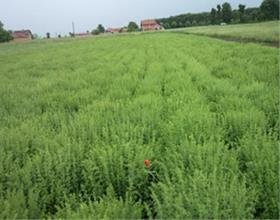
White oregano – Origanum heracleoticum L. fam. Lamiaceae
It circulates as:
The above-ground part of the plant - Origanum herba
Sheet – origanum folium and
Essential oil – Oregano aetherolum
Morphological and physiological characteristics
White oregano is a very perennial, green, semi-shrubby plant from the Lamiaceae family. It is characterized by a very strong and exceptionally branched root system with many fine roots. The above-ground part is characterized by a large number of stems (60-80 cm long), which are woody and often spread closer to the soil surface. The leaves are fine, about 3-4 cm long, with short petioles, while the flowers are white to yellow, and the entire plant has a very pleasant fragrance. The plant tolerates mowing well. White oregano remains on the same surface for 3-5 years.

Chemical composition
White oregano contains 1-1.5% essential oil. Oregano is especially used as a seasoning in cooking.
Conditions for success
Climate. It is a plant of hot climates, mostly adapting to sunny terrain. In terms of heat and light, it has very high requirements and can be cultivated throughout the country.
Soil. They do not have specific soil type requirements, but nevertheless, they thrive best in fertile, loose, and deep soils. They are not preferred in soils with high moisture.
Cultivation
Crop rotation. Like many perennial crops, white oregano is not subject to plant rotation. Oregano remains in the same plot for 3-5 years. As a pre-crop, it prefers crops that leave the soil loose. In the same plot, crops cannot be cultivated without at least three years of cultivation of other crops
Soil cultivation. The soil for cultivation should be plowed as deep as possible, immediately after harvesting the previous crop. Tillage should be done to a depth of 35 cm if possible. Soil preparation means fine-leveling and leveling.
Planting. White oregano can be cultivated in a permanent location in autumn and spring. In autumn, planting is done after the autumn rains, starting from mid-October and until climatic conditions allow. During this planting period, the seeds are placed a bit deeper to prevent them from sprouting. White oregano is planted at a distance of 60-70 cm in rows and 25 cm within rows. Thus, between 57,000 and 66,000 plants are needed per hectare. The spacing between rows should be arranged in a way that allows the use of machines for soil cultivation. Sowing can be done from seeds or seedlings.
Care
White oregano remains on the same surface for 3–5 years, and this crop requires special care; it is similar to long-standing crops: cultivation and mowing between rows, irrigation, etc.
Cultivation and tillage. With these measures, the soil is kept loose and free of weeds. This operation is carried out several times depending on the condition of the soil, tilling, and weeds. It is carried out with cultivation machines between rows.
Irrigation. Regardless of the fact that this plant is widespread in all dry regions, it responds exceptionally well to watering. Irrigation should be done after the first mowing, specifically in July and August, which will also achieve a higher yield. It often happens that mowing is done three times.
Harvesting. Mowing should be done at a height where the healthy leaves are, about 4-5 cm. In the first year, one mowing is done, while in the second year up to two mowings. The first mowing is done at the end of June and the beginning of July, and the second at the end of September and the beginning of October. Mowing should be done in good and dry weather. Drying is done naturally in a dark space with good ventilation or in a dryer at temperatures up to 45°C. From 4-5 kg of fresh mass, 1 kg of above-ground dry matter is obtained.
Yield. In the first year, 1000-2000 kg/ha of above-ground dry matter is obtained. In the second year and subsequent years, 3000–4000 kg/ha are obtained. From one ha of white oregano, 30-40 kg/ha of essential oils can be obtained.
The price per kg of dried oregano is €1.20/kg.
Available in: SHQ, ENG, SRB