
Morphological, physiological characteristics, chemical composition, and usage
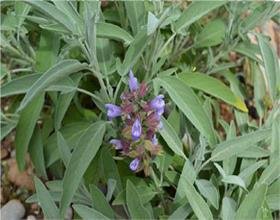
It is a perennial plant, has a developed root system, and for this reason, this plant is considered very useful against erosion. Since only the above-ground part is used, its cultivation in erosion soil and gravel soil has a dual use. The stems grow 50-80 cm. This plant belongs to the Laminace family and its morphological characteristics are the same as other plants in this family. The stem is not as branched and the lower part is woody. The leaves are arranged on the stem opposite each other (a botanical characteristic of the labial family). They have an elongated oval shape, a silvery-red color, with some very soft hairs. The flowers are blue to purple in color, gathered at the tips or on the side branches. The entire plant has a characteristic aroma and a sour taste. Flowering begins in May and lasts until the end of June. Sage flowers are very rich in nectar and serve as an exceptional pasture for bees. The seeds are round, 2–3 mm in diameter, and dark dark in color. The seeds have very high foliage, and the weight of 1000 seeds is 6–8 grams.
Chemical composition and use of the sage plant
The leaf contains 1.5 to 2% essential oil and tannin. It is mostly used as a spice and for the production of essential oils. It is used against sweating as tea, then for gargling, and against burning of the gum mucosa. Sage extract is especially valued for gum bleeding and strengthening of the dental muscles.
Conditions for success
Climate - Grows in dry and hot climates. The more pronounced these conditions are, the higher the content of essential oils. It tolerates harsh winters and is not well suited to humidity and cold weather during the growing season. It withstands drought but needs moisture during the initial planting and development phase. As altitude increases, the tannin content also increases.
Soil - It has no special soil requirements but thrives more in loose soils, with good water and air regime, as well as soils rich in humus.
Cultivation
Crop rotation – As a perennial plant, this factor is not particularly important, whereas as a pre-crop, it is necessary to be a weed crop.
Soil cultivation - It remains on the same plot for up to 10 years, so special care must be paid to the basic tillage. The basic tillage is done at the end of summer, at a depth of at least 40 cm. If weeds are present, then a surface tillage should also be done, because this is a perennial plant and removing weeds later is difficult.
Fertilization - Requires a lot of fertilizer. Requires barn manure in the amount of 20-30 t/ha, which must be applied during soil cultivation, that is, before planting.
Propagation - It is done by seed or by cuttings. The latter is used less. In widespread practice, sage is propagated by seed, either through seedlings or directly by sowing the seed in a permanent plot.
By seed, direct sowing is done in the field, 15-20 kg/ha, or in beds for seedling production before winter. Since the plant develops slowly at first, there are many weed problems and labor is required to remove them.
The productivity of seedlings in bark is currently the most widespread method. Sowing is done at the end of March or beginning of April. The seed is sown at a depth of 1 cm. Then the seed is covered with finely compacted soil. 8–10 g are needed per m². It germinates in 15-20 days. Newly sprouted seedlings are continuously watered. To prepare seedlings per hectare, 1.5–2 kg of seed is needed, which is planted over an area of 250–300 m². In October, seedlings are transplanted (seedling length 15–20 cm) into open ground spaced 70 cm apart between rows and 40–50 cm apart. Autumn planting with seedlings is preferable because there is enough moisture and the plant roots better during the winter period. The plant's roots have direct contact with the soil. If autumn planting has not been done, then spring planting should be done as soon as possible. Late spring planting is not preferred because sage seedlings are very sensitive to drought.
Sage planting can also be done by seed, using a special machine. The distance between rows should be 70 cm, the seed depth 2 cm, and within the row 30 cm.
Care
If sage has grown sparsely, then the gaps must be rearranged and filled. This activity is essential because sage is a perennial crop.
During the first year, it is very difficult because the plant needs support to grow and develop. To preserve the amount of essential oils, it is preferred that the plant be pruned to a height of 8-10 cm at the beginning of spring in the second year. In this way, many new shoots will develop, which will then produce many leaves. In the second year, it is preferable to remove weeds mechanically.
Harvesting - The first harvest is done in the second year after flowering. The above-ground part of the plant is cut to a height of 10 cm. Harvesting is done in the second half of July. The leaves are immediately separated from the stem.
Drying - The sheets are dried in a dryer within the first 2-3 hours at 55°C, and later about 1 hour at 40°C. Store in a dry and dark place.
As with sage and other plants, harvesting must not be done when there is field moisture.
Distillation is done with fresh sage; if that is not possible, it is dried, followed by distillation to extract the essential oil.
Yield - In the early years, yields are lower, but it increases starting from the third and fourth years, reaching its peak in the sixth year, after which yield begins to decline. From 1 ha, 3-5 t/ha of herb and 2-3 tons of dry leaves are obtained, while as a fresh mass 50-80 t/ha of fresh plants with 2 harvests. The drying ratio is 5:1. The kilogram of dried plants is 1 EUR
Harvesting should be done in the middle of the day when the temperature is highest, because at that time the amount of essential oils is highest during the day. The amount of essential oil is 30-50 l/ha. Its liter costs 120-150 EUR.
Available in: SHQ, ENG, SRB