
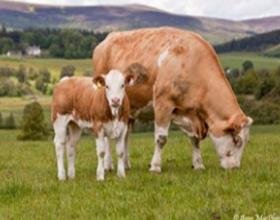
A history of the Simmental race
The Simmental cattle breed is one of the oldest and most dispersed breeds among all other breeds on every continent. The first herd of this breed dates back to 1806, but there are writings that even earlier the red and white cow were mentioned in church and secular property records of western Switzerland. These red and white animals were highly sought after due to their rapid development and growth, excellent production and quality of milk from which high-quality butter and cheese were made, as well as a large quantity of meat of very high quality.
Since its origin in Switzerland, this breed has spread across all continents. Today, it is estimated that there are around 40 to 60 million heads of the Simmental breed worldwide, with more than half of them in Europe.
The Simmental race is known by a variety of names, including "Fleckvieh" in Germany, Austria, and Switzerland, as well as many other European countries such as "PieRouge," "Montbeliard," and "Abondance" in France, and "Pezzata Rossa" in Italy. The name Simmental comes from their place of origin in the Simme valley of Switzerland. In German, Thal or Tal means valley, so the name literally means "SimmeValley."
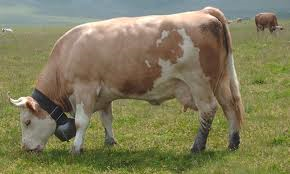
Characteristics of the Simmental (Fleckvieh) breed
The Simmental breed initially was a breed with combined meat-milk production, dominated by meat, and later high-quality milk. Today, however, the performance of this breed is continuously improving, and it is almost difficult to find herds with combined meat-milk production, because being interested in having a Simmental cow with higher milk production, scientists have managed through selection and crossbreeding to create a Simmental breed, where now its production is milk-meat.

The most important characteristics are:
- The Simmental breed is a strong breed with excellent resilience
- The live weight of this breed is 650- 850 kg
- They belong to breeds with combined productivity
- The Simmental breed easily adapts to different housing conditions
- It is characterized by easy calving and a large increase in calves after birth
- They have very minor problems with their hooves
- This breed continues to improve performance until the fifth lactation
- Very minor problems with mastitis, very healthy breast with
- an average number of somatic cells with fewer than 180,000 across all
- lactations.
- Depending on management, natural conditions, and nutrition, today there are herds with milk production up to 7000 kg with 4.2% fat, and 3.7% protein
- The daily intake of calves of this breed is 1300-1500 g with very good meat quality
It is very important that this breed is also widespread in our country and easily meets the conditions of Kosovo, and a large number of farmers on their farms focus on breeding this breed, taking advantage of the high potential for milk and meat.

Share
Available in: SHQ, ENG, SRB