
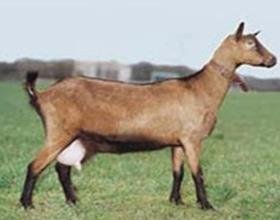
This breed originates from the French Alps, from which it also takes its name, and is distributed in many countries around the world due to this breed's ability to adapt.
A large number of experts have worked on improving and selecting this breed for more than 65 years.
Characteristics of the Alpine Breed
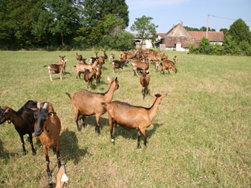
The Alpine breed can be found in several different colors and markings, but the most dominant color is red with a black stripe from head to tail; it can often have a black face and black legs. The Alpine goat can be horned or hornless.
The maturation rate in the Alpine breed (reaching sexual maturity) is about 5 months after calving. When a doe reaches this age, it is ready for breeding, and pregnancy in goats lasts about 150 days, where at 10-11 months of age the quince can produce two healthy kids. So, in this breed, fertility is 200%, which makes this breed even more important.
The alpine breed is a large breed with females measuring 70-80 cm in height, rams 90-100 cm, and males 80-90 cm in body length compared to about 100 cm in males. It represents the most widespread breed in France, accounting for 70% of the total number of goats. It has milk production of 600-800 liters, while record breeds reach over 900 liters of milk during a single lactation. Milk can be processed into butter, cheese, soap, ice cream, or any other dairy product usually made from cow's milk.
Milk quality in the alpine breed
The Alpine breed is known for producing high-quality milk with low fat content. According to the British Medical Journal, Alpine breed milk has the lowest fat content among all milk-producing animals (3.1 g fat / 250 ml milk), including cow's milk. It has higher lactose content than cow's milk but with lower protein values. Alpine breed milk contains 2.3 g of protein per 250 ml of milk, while cow's milk has 3.4 g per 250 ml.
In order to achieve higher milk production, experts have determined that four main requirements must be taken into account. The Alpine dairy breed must be housed in special conditions so that milk production is not affected by changes in external factors. Changes in external factors can cause a decline in milk production due to the pressure it exerts on goats to adapt to these changes.
The four factors for optimal production are; adequate ventilation, dry bedding, quality food, a well-balanced ration, and clean water available at all times. If they are grazed on pasture, they should take the shortest possible routes and be protected from various discomforts and diseases.
This breed has also achieved good results in our country in adaptation, fertility, and milk production.
Share
Available in: SHQ, ENG, SRB