
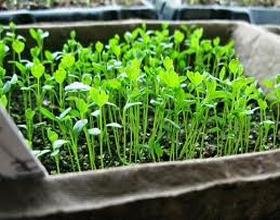
Cultivating vegetables in greenhouses as well as in open fields through the preliminary preparation of seedlings is particularly important because it determines the cultural cycle more accurately and the earlier harvesting of the crop. Since the plant vegetation is shorter when cultivated through seedlings, it allows the use of the soil for more crops within a year, both for open field vegetables and those in greenhouses. It also eliminates the problems of weak and rare sprouts, such as direct seed planting, while achieving greater uniformity in plant growth since there is the possibility to select the healthiest seedlings and remove those with weak development.
Traditional production of vegetable seedlings
A large portion of vegetable seedlings are still traditionally produced in warm barns with bioheating (fresh manure mixed with straw). In these fields, seedlings are cultivated for 70-80 days during the winter period, which means planting should begin, especially for pepper seeds, no later than the end of January to the beginning of February.
Preparation of bioheating - the most accessible and relatively higher quality for this purpose is cattle manure, which contains 80% moisture and 0.45% nitrogen. The manure is mixed with finely chopped straw and five to six days before being laid on the bark, it must be piled up to initiate the fermentation process. The height of the bioheating layer depends on the time it is prepared. In the winter months, a thicker layer of 40-60 cm is applied, while in less cold months, a 20 cm layer is sufficient. Once the bioheating layer is arranged, it is leveled and pressed with a board, stepping on it so that excess air can escape, which will achieve a longer-lasting and more balanced combustion of bioheating. By using cattle manure, the entire surface of the bark is moistened with lime milk or unquenched lime, thus preventing the development of fungi. Then the frame is installed and the bark is closed with a glass window, a stake, or a ridge, and after two to three days, once the heat is turned on, the soil is arranged.
Soil preparation - from unexploited surfaces, uncontaminated by diseases and weeds, a layer of soil is taken and mixed in a 1:1 ratio with well-burnt organic manure. Sieves are fine-sifted to remove soil crusts and obtain the best possible structure. The soil prepared in this way is arranged on the bark in layers of 10-12 cm. After 4-5 days, when the soil warms up, seed sowing can begin.
Seed planting - The planting rate varies depending on the type of vegetables and whether transplanting will be done or not (see the table below). Seeds can be sown either in advance or in rows spaced 4-5 cm apart. After distributing the seeds, cover them with 1-1.5 cm of specially prepared soil from two parts well-burned organic fertilizer and one part soil. Then the soft soil is pressed to come into contact with the seed, and a light irrigation of the sowed seeds is carried out. Windows are closed over frames and racks are placed to allow for dark conditions until germination.
The air temperature inside the bark should be maintained at 20-22 °C, while the soil temperature should be around 25 °C. Under such conditions, the seeds should germinate within 5-6 days. As a result of intensive fermentation of bioheating, gases will form that can damage the seedlings, so the bark should be regularly ventilated.
Rodishes (various covers) are removed when one third of the seeds have sprouted, window frames are removed, and the temperature is reduced to 10-12 °C, maintaining this for the next 12-15 days. This "cold treatment" should initiate faster formation of the first trunk/stem and prevent excessive seedling growth. Until seedlings are transplanted, the temperature is maintained at 18-22 °C. Seedlings should be freed from weeds and treated once or twice with Previcur Energy at a concentration of 0.15% solution or Ridomill plus 48 WP at a concentration of 0.3% suspension. If necessary, Fudazol, Benlate, or Benomil can be added at a concentration of 0.05%.
The seed planting rate with and without transplanting as well as the number of plants per m²
|
Type |
Planting rate g/m² |
Number of plants per m² |
||
|
With transplanting |
Without transplanting |
With transplanting |
Without transplanting |
|
|
pepper |
10-12 |
4-6 |
170-200
|
600-1200 |
|
Tomato |
6-8 |
0.8-1 |
100-125 |
350-600 |
|
Watermelon |
|
4-5 |
|
150-200 |
|
Lettuce |
5-8 |
2-3 |
150-200 |
900-1000
|
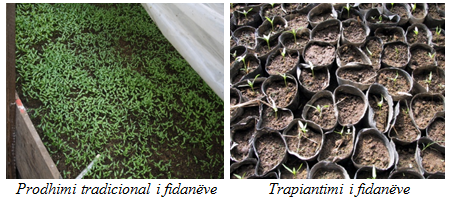
Industrial seedling production Industrial seedling production has considerable advantages compared to other cultivation methods (seedlings with bare roots, or those grown in traditional cubes). This system is based on the utilization of industrially processed raw materials, a high degree of mechanization of production processes, and a high level of automation in microclimate control within seedling production environments. Industrial seedling production is carried out in trays containing 40–400 individual cells. Separating the seedlings into cells means that each individual seedling is provided with sufficient water and nutrients.
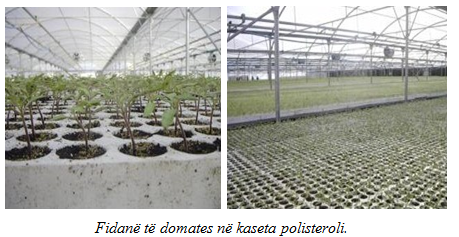
Trays for seedling production. Seedling production can be carried out in polystyrene trays (fish bread) or plastic. Regardless of the material produced, the trays differ in the number, size, and shape of their cells (modules). Polystyrene trays are the most commonly used, mainly due to their lower cost. In recent years, under the influence of environmental protection demands, these have been replaced by rigid plastic trays. As a rule, plastic trays are used for many consecutive plantings, but polystyrene trays can also be used for more than one planting. In any case, the repeated use of trays must be accompanied by prior disinfection with fungicides and broad-spectrum insecticides. Immersing them for a few seconds in tanks filled with a concentrated copper sulfate solution (3% horse stone) is the simplest method.
Substrate for filling the trays. The substrate used for filling the trays is also known as compost. Although pots for seedling production can also be produced artisanally (by decomposing organic waste, manure, etc.), utilizing industrially produced composts is safer and more effective. Regardless of whether the compost used for seedling production is industrially or artisanally, it must meet all the following requirements:
- · be physically uniform and have free flow to allow uniform filling of the modules,
- · very good water-retention characteristics, so it does not lose its structure during irrigation, but at the same time allows for light wetting in case it dries,
- · provide a uniform environment for growth and enable the formation of a root tang that does not break down after leaving the modules,
The fertilizer content in compost is important, and it would be desirable for it to contain sufficient amounts of all macro and microelements. However, seedling growers have many opportunities to control seedling growth through liquid fertilization. Changing the nitrogen content in compost is the main way to control seedling growth.
Seed quality. An essential requirement for industrial seedling production is high seed quality. It is very important that seeds, in addition to high germination power, also have high germination energy. As a rule, the seeds used must have germination power of no less than 90%. The loss of seed germination energy is, in most cases, an indicator of their long production period (aging) or unsuitable storage conditions.
Filling and planting the trays. Filling the trays with compost can be done manually or mechanically. Filling should be done through the free flow of the substrate into the cells, flush with their surface. After filling with substrate, the trays are gently shaken, but it is not necessary to apply force to compact the substrate. Compacting is easily achieved through subsequent irrigation.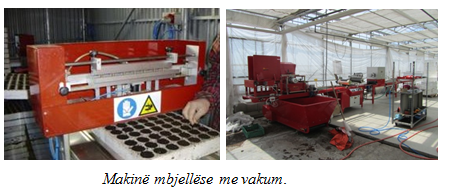
Seed sowing in trays can also be done manually or mechanically, using vacuum sowing machines. After planting, the trays are covered with a thin layer of vermiculite, after which modern planting machines automatically irrigate the trays. Otherwise, this irrigation should be done by hand, in the form of rain, but with care that the water stream does not reveal or displace the sown seeds. Irrigation should be such that it allows for complete and even watering of the substrate throughout the depth of the cells. To facilitate this process, if the substrate is dry, it is moistened sufficiently before filling the trays.
Germination. The trays should be placed in special pre-germination chambers on pallets (100-150 trays/pallet) until germination begins. The temperature in these environments, until the first sprouts appear, is maintained at 25-28 °C. The storage time of the trays in these environments lasts 48 to 72 hours, depending on the type of vegetables and the germination energy of the seeds. In general, the shelf life of seeds of plants from the Solanaceae family is longer. Immediately upon the appearance of the first sprout buds, the trays are sent to the greenhouse, exposed to full light, while the ambient temperature drops to 12-16 °C. Under these conditions, solary germination is completed in 5-7 days, pumpkins in 3-5 days, and cruciferous plants in 2-3 days.
During germination, special care must be taken to keep the substrate continuously moist. For this purpose, in the pre-germination room, the relative humidity of the air is maintained at 95-100% (in the germination rooms, this is achieved through continuous misting of the environment), while after the trays are released in the greenhouse, periodic watering is done as needed. It is very important that the ambient temperature is consistent in every part of it at all times. Otherwise, there will be irregular germination and then significant differences in plant growth intensity.
Lighting. Undoubtedly, light is the most important factor for seedling growth, which is why special attention is given to ensuring full illumination. The lack of lighting manifests as prolonged and etiolation (stem bleaching) of the seedlings, increased susceptibility to fungal diseases, and most importantly, a reduction in the future productive potential of the plants. The lack of lighting cannot be corrected by installing conventional lamps, no matter how powerful they may seem. Full lighting can only be achieved through the installation of special lamps with very high power. Despite its high cost, artificial lighting for seedlings is, in most cases, economically justified.
Aerial pruning of roots. The basic principle of producing module seedlings is aerial root pruning. The trays should be supported on tables, wooden blocks, stretched wires, etc., so that they are isolated from the ground with an air layer of at least 5 cm. The preferred height from the ground is 10 cm. Aerial pruning is based on the fact that the root tips die when the roots come out of the trays and come into contact with air, thus promoting the formation of a root tangle inside the tray nests. Placing the trays directly on the soil surface, uncovered manure, on cement surfaces, or on plastic sheets is wrong because it allows roots to grow outside the trays and allow them to penetrate the soil, or (in the case of cement surfaces and plastic sheets) the creation of a dense root layer at the bottom of the tray. Correct placement of trays, accompanied by appropriate cultivation technology, enables the formation of a well-developed root system that easily detaches from the tray.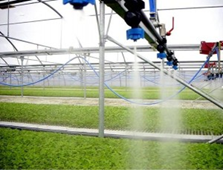
Watering. The greatest water requirements of plants occur during seed germination. For this reason, immediately after planting, irrigation is done with a sufficient amount of water to ensure complete hydration of the substrate. After this point, under no circumstances should the surface of the compost be allowed to dry out until the seeds have fully germinated. High-quality seedlings can only be obtained through proper irrigation. If hand irrigation of seedlings is common on limited areas, large producers necessarily need to install mechanized irrigation systems. The most effective irrigation system is the portable rainwater system, which allows the mechanical movement of irrigation sprinklers in every segment of the nursery. In some cases, the side cells of the edge trays may dry out faster than those in the center of the blocks. In these cases, supplementary hand irrigations are necessary. The number of irrigations depends on weather conditions and the phenological stage of the seedlings. Irrigation should be such that it achieves minimal water runoff from the modules and minimal loss of nutrients from them.
Liquid fertilizations. Seedling growth can be controlled by managing the quantity and ratios between the basic nutrients. In general, industrial compounds used in seedling production are enriched with various nutrients and can ensure normal nutrition of seedlings for most of their time in the trays. However, in certain situations, intervention with different fertilizers may be required to make the necessary corrections. The small volume over which the root system extends and the high intensity of seedling growth often make fertilization necessary. Fertilizers can be added through irrigation systems via various injection systems. The frequency of fertilization depends on the condition of the plants, phenological stage, and weather conditions. The main nutrient element that regulates the intensity of seedling growth is nitrogen.
It is essential that during interventions to control seedling growth, small doses are used to avoid promoting excessive or uncontrolled vegetative growth of the seedlings. Meanwhile, the phosphorus concentration in the nutrient solution of seedlings should be between 15 and 40 mg/liter and potassium from 100 to 200 mg/liter; the guideline nitrogen concentration rates are as follows:
- Tomatoes 50-100 mg/liter
- Pepper 100-150 mg/liter
- Cabbage 100-150 mg/liter
- Pumpkins 100-150 mg/liter
The impact of module (cube) size on the qualities of the seedling. Early production is proportional to the size of the modules, but this is not the case with total production. If the goal is early production, seedling growth should be done in large-sized modules. Conversely, production in small-sized modules is more economical. The advantage of larger modules related to early or total production is evident if transplantation is done before the start of flowering. Conversely, before transplantation, flowers or fruits must be removed.
Controlling the length of seedlings. The temperature difference method (DIF) is the best way to control seedling heights. DIF is calculated by the difference between daytime temperature and nighttime temperature. A positive DIF value favors accelerated plant growth, whereas a possible negative value, on the contrary, will slow down plant growth. High temperatures in the first 3-4 hours after sunrise cause excessive seedling extension. This can be prevented by maintaining lower temperatures in the early morning hours than nighttime, but not less than 10 °C. Usually, negative values of 4-5 °C for DIF allow good control of plant height.
The irrigation regimen is another powerful tool to control seedling growth. The low frequency of watering, prioritizing morning watering and minimizing watering during the hottest hours of the day or on days with limited light, positively affects the production of seedlings with short trunks. Swinging or slight bending (several times a day) is another good opportunity to produce seedlings with short and thick shoots without damaging their production capacity.
Age of the seedlings. The duration of seedlings staying in the tray should be determined depending on the size of the modules, the type of vegetables, and the cultivation time. The longer the seedling stay in the tray, the more the growth of the seedlings will be inhibited underground and above-ground, and the more their growth intensity will decrease. Specifically, if the time the seedlings remain in the tray exceeds their active growth phase, their connection to the soil after transplantation will become more difficult, and their expected yield will be significantly reduced. The indicative values of the seedling stay time in trays, depending on the species, the number of seedlings in the tray, and the production time, are presented in the following table.
|
Culture |
Number of seedlings in the tray |
The optimal duration for seedlings to stay in the tray (days) |
|
Early tomato |
60-84 |
55-60 |
|
Medium tomato, late |
120-170 |
35-40 |
|
pepper |
120-170 |
60-65 |
|
eggplant |
120-170 |
60-65 |
|
Early cucumber |
40-60 |
25-30 |
|
Medium cucumber |
60-84 |
15-20 |
|
Ungrafted watermelon |
84-120 |
20-30 |
|
Grafted watermelon |
60-84 |
35-45 |
|
Cabbage / cauliflower |
170-256 |
25-35 |
Hardening of seedlings. "Hardening" is the term that refers to the final preparation of seedlings for planting in their permanent location. It refers to reducing growth rate, increasing dry matter, and enhancing the seedling's resilience to possible stresses of the new environment where the seedling will be relocated. However, it is important to emphasize that hardening should be done carefully and only during the last days of their stay in the production site, because prolonged and excessive hardening would negatively affect both the speed at which the seedlings set to the soil and their future production.
The main methods of carrying out hardening are;
- Irrigation; the gradual reduction of the amount of water used for irrigation and the duration of watering decreases the intensity of seedling growth. However, under no circumstances should the substrate dry out be allowed to the extent that it causes seedling wilting.
- Temperature; Lowering the temperature to the level of the plant cultivation environment allows the seedlings to fully acclimatize before emerging in their permanent location.
- Fertilization; Reducing or completely stopping nitrogen fertilizers before the hardening process increases the dry matter content in the plants. However, 1-2 days before transplantation, it is recommended to apply fertilizers with high doses of nitrogen to supply the seedlings with a sufficient amount of nutrients for the first days after transplantation.
Fertilization before planting. Shortly before being transported to the field, the seedlings are watered abundantly with water containing a high content of phosphorus fertilizers and less nitrogenous ones. Such fertilizations (starter) greatly help in quickly connecting the seedlings to the soil, because they provide the seedlings with a reserve of nutrients that are easily assimilable for the first days after transplanting (this is essential in early plantings, when due to low soil temperatures the activity of the root system is very limited) and at the same time stimulates the rapid activation of the root system and its connection to the soil in its permanent location. At the time of planting, the substrate must be in full field water-holding capacity. Such a measure would reduce the water stresses of the plants at the time of transplanting to their permanent location and would also enable their quick connection to the soil.
Control of diseases and pests. Complete hygiene of the trays and the substrate used for seedling production is essential. Diseases that overwinter in the soil can be transmitted from one production cycle to another through undisinfected trays. Plastic trays can be disinfected by soaking them in formalin solutions, while polystyrene trays (fish bread) can be treated with broad-spectrum fungicides. Seedling treatments during growth depend on the nature of the problems that arise during their growth.
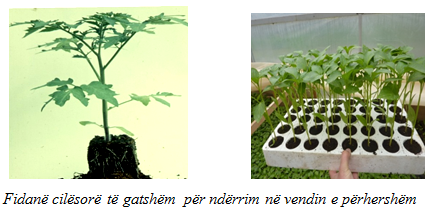
Qualitative indicators of vegetable seedlings. Unlike fruit trees, there are no quality standards for vegetable seedlings. However, there is a broad understanding that quality vegetable seedlings are considered those that meet the following criteria;
- They are free from diseases and pests.
- They have leaves and stems that are dark green in color and have a high chlorophyll content.
- They have a well-developed root system, without symptoms of rot or scalding.
- They have strong and well-developed stems.
- They have a sufficient leaf surface.
- They possess the ability to quickly attach to soil after transplantation and have high potential for rapid growth after rooting
Available in: SHQ, ENG, SRB