
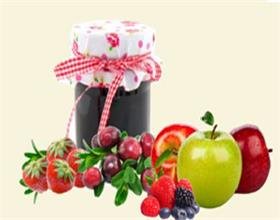
STRAWBERRY PROCESSING
Being an herbaceous plant, strawberries require a different cultivation from other shrubs and climbing trees. Among fruit species, strawberries enter production earlier than planting and are the earliest fruit on the market in spring. The ripening of strawberry fruits in open fields begins in mid-May and continues until the end of June. However, this can vary depending on climatic conditions, variety, and cultivation method
Strawberry fruits, besides being sold as fresh products, are processed into various products such as: molasses, marmalade, jam, jam, and strawberry juice.
strawberry molasses
This molass can be prepared together with berries, ribs, or simply from strawberries.
Strawberries (but also if we add other trees) are pressed with a press. The prepared trees are placed on the stoves to be boiled and stirred from time to time, and when they get the first wave, the heat is lowered slightly; after half an hour of boiling, sugar is added, and for 1 kg of strawberries, 1 kg of sugar.
This molass is cooked until the bottom of the container is visible during stirring. Hot jars are filled with hot molasses, placed in a hot oven at 100-150 °C, the oven is closed, and the stove is stopped where the jars are not hermetically sealed to create a crust layer on the surface of the molasses. They remain in the oven until morning, where they cool slowly; once cold, they are sealed slowly with a lid and left in a cool place.
If larger plastic packages are used, the plastic is filled when the molass cools, then placed in a deep-freezer refrigerator, and when needed, they are taken out and thawed.
Strawberry jam - I
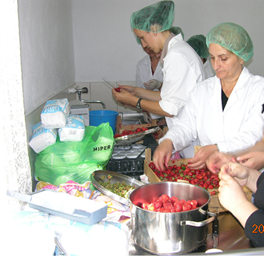
1 kg strawberries, 1 kg sugar, 40 g lemon soda
In the bowl where the jam will be cooked, place a row of strawberries and a row of sugar. (1 kg of strawberries: 1 kg of sugar or a 1:1 ratio). And so on, arrange until the strawberries are used up and leave them overnight.
In the morning, they are placed on the stoves and stirred constantly to prevent sticking to the container. These are boiled until the bottom of the container is visible. Half an hour before continuously removing from the heat, the jam is stirred. In 5kg of jam, 10g of lemongrass is added (20kg of jam ÷ 40g of lemongrass). When the hot mixture boils, it is placed in jars and treated the same way as when preparing molasses.
Strawberry jam – II
2 kg strawberries, 1 kg sugar
The strawberries are thoroughly cleaned, drained, and mashed with a wooden spoon; they are placed in a mesh for 10 minutes until the water releases, then placed in a pot and boiled over high heat, stirring continuously until thickened.
To check if the jam is cooked, we take a porcelain plate and place a spoonful of hot jam on it. When it cools (it is placed in the refrigerator to cool faster), if the jam does not spill, it is ready to be preserved.
Pour the hot jam into hot jars
Strawberry jam (with pectin)
6 kg strawberries, 3.5 kg sugar, 30 g citric acid (citric acid), 100 g pectin
We pour 6 kg of strawberries into the jam boiling bowl and start boiling. We measure 3.5 kg of sugar, and after approximately 10 minutes from the moment of mixing, we add 3.3 kg because we separate 200 g of total sugar for mixing with pectin. We add 100 g of pectin, which should be well dissolved in a mixer in 1 liter of hot water, being careful not to leave any pectin pectin remaining. Before finishing the jam boiling process, we add the pectin. Then also the citric (limontonic) acid, which has been dissolved in water. Once it boils a little more, we put them in containers (jars), turn them upside down with a lid on where they stay for 5 minutes, then put them in the pasteurizer for 20 minutes, after removing them from the pasteurizer, let them cool for a while, then place them in cold water to complete the processing.
Strawberry jam
1 kg strawberries, 300 g sugar, 60g citric acid (citric acid)
In a container, we put 2 liters of water and 60g of lemon soda. Then we put all the prepared strawberries for jam into this water, and when we remove them from this water, we sprinkle these strawberries with a little lemon and let them sit in a container where the container should be shaken from time to time so that all the strawberries are moistened with lemon juice, but under no circumstances should you stir them
When all the strawberries are moistened with the lemon juice, let them sit for 1 hour, and then in the pot you want to boil, add one layer of strawberries and another layer of sugar. For 1 kg of strawberries, add 250-300g of sugar and let them sit overnight. In the morning, place them on high heat until they start boiling, then remove them from the heat and cover them with a damp cloth, and they should remain away from the heat for 15 minutes (during this time, the strawberries release their juice). Then they are placed back on the stove and boiled until they reach 2-3 more cycles on a not very high heat (30 minutes), after which they are removed from the heat again and covered with a damp cloth, left to cool slowly overnight, and in the morning we put them in jars, seal tightly with lids, and leave in a cool place.
You should be careful that in this case the strawberries are not stirred with a spoon, but only occasionally move the container in which they are cooked. The container should be half the size of the number of strawberries so that it does not swell during boiling, and if there is foam during boiling, the foam is removed with the spoon but never stirred. If you do not have a lid to close the jar, cellophane is used for airtight sealing, which is cut into a size slightly larger than the jar's neck and placed in brandy or alcohol, then placed wet over the jar so that when it dries, it expands and thus the jar is closed. This sealing method can be used for any other preservation if the appropriate lids do not exist.
strawberry juice
3 kg strawberries, 1/2 liter water, 1 kg sugar
The strawberry fruits are placed in a small container with very little water. The container with the fruit is placed over another larger container in which hot water is boiling. Under the influence of the steam and water temperature, the fruits are softened and then pressed.
For every liter of squeezed juice, add 150 g of sugar.
The liquid obtained in this way is poured into bottles, sealed, and pasteurized at 85 ºC for 20 minutes.
The second method of Strawberry Juice
Such juice can also be obtained by sprinkling 200g of sugar per kilogram of strawberries over peeled fruits, which are then left as such for 12 hours or overnight to strain.
The juice obtained by juicing the fruits is poured into a bottle, sealed, and then pasteurized for about 20 minutes at 85ºC
Mountain strawberry juice
3 kg of cleaned mountain strawberries, 1/2 liter of water, 1 kg of sugar
The strawberries are placed in a small container with very little water. The container with the fruit is placed over another larger container in which hot water is boiling. Under the influence of steam – water, the fruits are softened and then pressed. For every liter of the squeezed substance, 150 g of sugar is added. The juice obtained in this way is poured into bottles, they are sealed, and they are boiled (pasteurized) at 85 ºC for 20 minutes.
Such juice can also be obtained by adding 200 grams of sugar per kilogram of peeled fruit, which is then left as such for 12 hours or overnight to strain.
The juice obtained by juicing the fruits is poured into bottles, sealed, and then pasteurized for about 20 minutes at 85 ºC.
Available in: SHQ, ENG, SRB