
Cultivating tomatoes in protected environments is a highly complex and delicate process, carried out through the correct application of a series of agronomic interventions, such as soil preparation for planting and planting of plants, determination of planting density, pruning, programming the formation of the first fruit, leaf removal, pollination, optimization of fruit size, plant training, feeding, harvesting, and harvesting time.
Microclimate control in greenhouses – This control is essential for the success of tomato cultivation and is carried out through manual or automated monitoring of temperature, relative air humidity, and carbon dioxide.
The basis for determining the optimal values of these indicators is the lighting intensity in the greenhouse.
Temperature regime - It is important in determining tomato production, as the plants' temperature requirements vary depending on their phenological stage. Regarding this, in the following table we have presented the required temperature regime in the greenhouse.
| Phenological phase | Minimum temperature (°C) | Optimal temperature (°C) | Maximum temperature (°C) |
| Mbirja | 11 | 16-29 | 35 |
| Growth | 18 | 21-24 | 32 |
| Optimal temperature (°C) in the greenhouse depending on lighting | |||
| The night | |||
| 15 | 25-28 | 17-19 | 21-23 |
IncreasingCO2 concentration up to 1000 ppm is an effective way to compensate for limited lighting and maximize early production. On sunny days, without artificially addingCO2, tomato plants reduceCO2 concentration in greenhouses by up to 250 ppm. For every 100 ppmCO2 artificially added above this level (250 ppm), there is the potential to increase production by 2.6 kg/m². The problem is that enriching greenhouses withCO2 in summer is costly if greenhouse windows are open, for the simple reason that it would escape into the atmosphere.
Water regime - Water requirements are high, although tomatoes are known for their resistance to water stresses. Soil moisture should be 70-80% of its water-retention capacity, while air humidity should be 50-70%. To meet these requirements, plants require frequent watering but with controlled water levels.
Preparation of the greenhouse and soil for planting - After harvesting the previous crop, the greenhouse is cleaned of plants, thorns, weeds, plastic waste, etc. Then, repair of the greenhouse structures, ventilation systems, heating, irrigation, etc., continues.
Soil tillage should be deep, 30-40 cm, in order to subvert its surface layers to depth, with a physically damaged structure saturated with overwintering reserves of plant parasites and salts, to replace them with layers found more deeply. The first deep soil tillages are followed by one or several shallow surface tillages, tilling, loosening, leveling, etc., until the formation of a suitable root bed.
Before the main works are carried out, organic fertilizers are spread on the soil, while in very poor soils, a portion of phosphate and potassium fertilizers is also distributed. Meanwhile, even before preparatory works, the majority of chemical fertilizers intended for basic fertilization and the portion of pesticides planned for chemical soil disinfection are distributed.
Depending on soil fertility, the intensity of infection from pest diseases, the method of planting the plants, and the spread of pesticides, they can be applied over the entire surface or in bands. After this, the soil is watered and the greenhouse is left closed for some time. This is done with the aim of reactivating the soil's microbial flora.
Depending on the method of planting the plants, the soil can be left flat or raised clusters can be formed. Forming raised clusters creates many advantages compared to the first method (flat cultivation form) because the soil warms up faster and more (the temperature of the valleys is 2-3 °C higher than that of flat soil) and drains better and more efficiently. For this reason, the root system of the plants grows better and is more active, especially in early plantings. Planting plants in raised valleys is essential for heavy soils, saline soils, and those with a high level of groundwater.
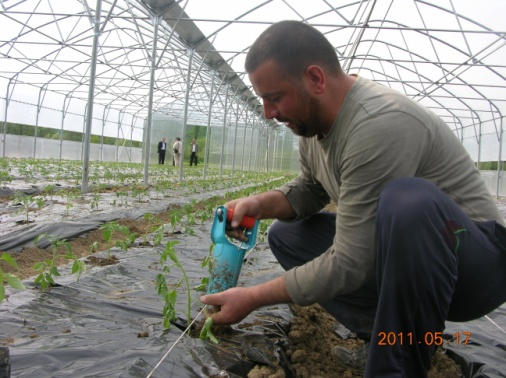
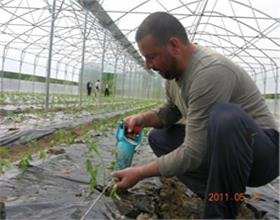
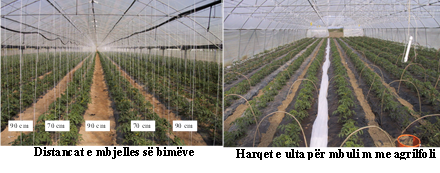
Seedling planting - Greenhouses are planted with quality seedlings in the previously prepared soil, where, after the formation of greenhouses, the drip irrigation system pipes are laid along their length. After this, if the soil is to be mulched, plastic sheets are placed on top of them and fixed, covering them with soil on both sides of the greenhouses.
A few days before planting begins, irrigation is done with relatively high doses of water, and then the soil is left in such a state that at the time of planting the water content in the soil reaches 70-80% of its water-holding capacity. Seedlings are placed at the calculated plant distances in rows, flush with the soil surface. If the soil is mulched, plastic sheets are first cut into circular or round shapes. Immediately after planting, watering is done with small doses of water (0.5-1 liter per plant) to ensure quick connection of the plants with the soil
Tying the plants - done after planting, and the longer the seedlings are, the sooner they should be tied. The traditional string tie at the base of the plant stem is now being replaced by simply inserting the end of the twine into the ground, near the plant. Delay in tying, especially when plants are long and bent, can cause the plant to break.
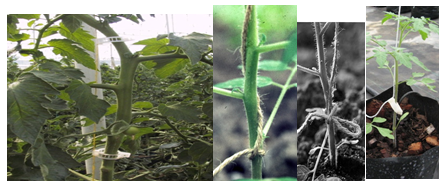
Pruning - applied to pinch the top of plants, to stop the growth of plants at height, and to eliminate lateral shoots. Tip plucking favors fruit growth and thus ensures a greater weight for them. For this reason, pinching the plant tip at the end of the growing season is always beneficial. All lateral shoots (axillary shoots) are pruned on tomatoes, except those left to control the density of plant stems per unit of soil surface. Axils should be carefully removed no later than after a leaf has formed, because delayed removal causes growth and developmental disorders as a result of competition for assimilation, and likewise, delaying this procedure causes larger wounds on the stem and becomes a source of infection.
Leaf removal - The development and lifespan of leaves on the plant depend on temperature, so at high temperatures (28 °C), a particular leaf becomes infectious 76 days after it emerges. Under the same conditions, the leaf fully matures 56 days after emerge or after the formation of 7 flowers and begins to age after 76 days. This means that at all times the plant must have no fewer than 21 leaves, and at most, their number can reach up to 27-30 leaves. At average temperatures of 18-21°C, the maximum number of leaves that should be maintained on a plant is 30-33, while generally the flower where fruit browning has begun is freed from the leaves. Too rapid leaf removal from plants is not desirable because it reduces the plants' assimilation ability.
Leaves can be removed rhythmically, from one to a week, but this can also be done by removing two or more leaves at the same time at specific time intervals. Leaf removal is done to reduce vigorous vegetation since plants may have problems with fruit set, then to improve air circulation in the plants and thus reduce the risk of diseases, and likewise, leaf removal improves fruit ripening and uniformity in fruit color under conditions of limited lighting. Care should be taken to remove fewer leaves from the side rows of the greenhouse in order to better protect the fruits from sunburn
Available in: SHQ, ENG, SRB