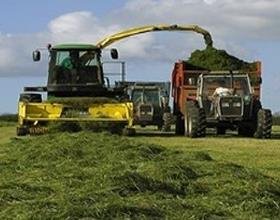
Silage of green mass – grass, alfalfa, and other types of feed – has been applied for a long time in many countries around the world and is rapidly expanding. In European countries, more than 90% of the animal feed produced is preserved as silage. The reason for this is the rainy periods at the time of the first mowing, then silage preparation is fully mechanized, and the number of heads per farm is very large.
Silage-based feed from grass or corn is mainly the main source of bulky feed in ruminant feeding. Milk production and the economic aspect of silaged feed are the main factors in assessing how much animals should be fed silage.
Methods for preparing grass silage
There are different methods for preparing grass silage. All methods aim to preserve the food and maintain quality for a longer time.
• Preparation of the grass silage using rotoball equipment
• Preparation of grass silage by field typing and silage in silos
• Preparation of silage for grass in nylon sacks or other equipment (for small farms)
• Preparation of hay silage directly from mowing
What are the advantages of preparing silage?
• Silage-based food can be preserved for a long time
• It is a food rich in energy and protein (depending on the type of silage) and can replace some concentrated foods
• It is a tasty food for animals
• Nutrient losses are minimal
• Small surface area for food storage
Optimal mowing time
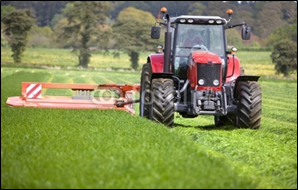
Mowing should be done at the right time. As the plant matures, the quality of the feed decreases (the cellulose content increases, while the nutritional value decreases). Natural meadows should be mowed at the beginning of the ears, while alfalfa should be mowed before the start of flowering. The quality, not the quantity, for mowing increases milk production during lactation.
Mowing height
The minimum mowing height above ground level should be 6-7 cm. It can be higher, depending on the condition of the soil surface.
Advantages of minimal mowing:
• The grass grows faster
• Reduces the risk of soil contamination
• Reduces the risk of contamination from various bacteria
Moisture and crushing or cutting of the silage mass
The silage mass should have the appropriate moisture content of 60 to 65%. It should also be ground as briefly as possible, 75% less than 1 cm and 20% longer than 3 cm. It is recommended that the silage be covered as soon as possible, within 24 hours.
Compression of the silage mixture
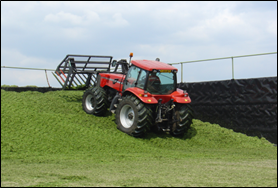
• The purpose of compacting the silage mass is to remove all the air
• To achieve the best possible compaction, the silage layer should be 12 to 15 cm thick.
• The weight of the tractor for compaction silage should be as high as possible. Every additional kilogram during compaction improves the quality of the silage.
• Compression of the silage mass must continue without interruption.
Silage covering
• After removing air from the silage mass, the best possible coverage should be made to prevent air from entering.
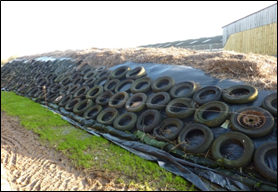
• Use high-quality plastic material for covering.
• The edges of the silos must be well covered.
• Place sand or other materials on top of the silage to create pressure on the silage mass.
• The ideal time for silo covering is within 24 hours.
• Occasional silo inspection
During feeding, the deterioration or decrease in silage quality can be minimized if:
We take the necessary amount of silage for feeding. In summer, remove 15 cm per day, while in winter remove 5 cm per day. Silage cutting should be done vertically. Silage opening should be done gradually, as needed
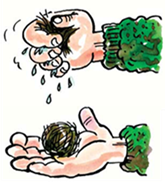
The determination of dry matter on the farm can be done by manually pressing silage
Squeezing the silage mass
LTh %
Very liquid is when the silage drips lightly during hand squeeze
<20
Moderately liquid is when the silage drips with difficulty during hand pressing
20–25
There is little or no liquid when pressing by hand, but the hands are wet
>25
Calculation of the amount of silage in silos
First, to calculate the amount of silage in a silo, we need to know the size of the silo. Length (m) x width (m) x height (m) x (0.6, but this number varies from the percentage of LTH - dry matter)
Example: if the silo is of these sizes:
18m long x 4m wide x 2m deep = 144 m³. To convert how many tons of silage we have to 30% LTH, multiply it by 0.6
144 m³ x 0.6 = 86.4 tons of fresh silage.
Determining the size of the silo
If we have this amount of silage produced and the requirements on our farm are for 91,250 kg of silage per year, then we determine the size of the silage as follows:
In 1m³, 600–700 kg of silage mass can be placed.
91250 ÷ 600 kg m³ = 152 m³ is the volumetric space of the silo.
If, as an example, we want to build a silo 2 m deep and 4 m wide. When we have the width and depth, then we determine the length of the silo as follows:
2m x 4m = 8,
152 m³ ÷ 8 = 19 m of silage length will be needed to install the entire amount of silage produced.