
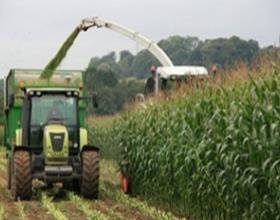
Corn silage is primarily the primary source of bulky feed in ruminant feeding. The quality of the feed and the economic aspect of corn silage are the main factors in assessing how much animals should be fed corn silage. In European countries, more than 90% of the animal feed produced is preserved as silage.
Advantages ofcorn silageproduction
• Corn silage can be preserved for a long time
• It is an energy-rich food and can replace some of the
concentrated foods.
• It is a tasty food for animals
• Nutrient losses are minimal
• Small surface area for food storage
Organization of work during the preparation of corn silage:
• Harvesting at the right time
• Cutting or crushing the silage mass as thoroughly as possible
• Corn kernel cracking
• Pressing and removing oxygen from the compressed mass for silaging
• Hermetic covering of the silage-covered mass with plastic foil
• The capacity of the silo must be adequate for the amount of raw material that will be
we silage
• It is not practiced that the depth of the silaged mass be less than 60 cm
• The filling and compression of the silo must be harmonized
• The entire process must be completed as quickly as possible,
The ideal time is one day, at most three days.
Optimal time for harvesting corn for silage
- The optimal time for harvesting is when the dry matter is 30–35%
- The determination of dry matter is determined based on the milk line in the corn kernel

How to determine dry matter or the optimal time for harvesting corn for silage
- The corn trap for silage is taken and divided into two parts. In corn kernels, the boundary between the hard and soft parts or the milk line in corn grains is required.
- If the milk line or portion is found in half or more of the corn kernel, then the dry matter content in the silage is about 30–35%.
- If the milk content is less than half of the corn kernel, then the dry matter content is around 24–27%.
Crushing or cutting corn for silage
- Cutting as fine as possible enhances the quality of the silage.
- The particle size should be about 1 to 3 cm.
- Cutting to this size increases the quality of the silage, compaction is better, and the amount of silage per 1 m³ is greater.
Compression of the silage mass
- The purpose of pressing corn for silage is to remove all the air present in corn for silage.
- To achieve better compression, the layer of silage mass should be 10 to 15 cm, which helps us compact the silage as well as possible.
- The compression of the silage mass must continue without interruption.
- If possible, compression should also be done after 24 hours.

Silage covering
- After removing air from the silage mass, the silage must be covered as well as possible to prevent air from entering.
- Use good quality plastic material for covering.
- The edges of the silo must be well covered.
- Place sand or other materials on top of the silo to create pressure on the mass of
silage. - Check the silo from time to time to avoid damage to the plastic foil cover.
Fermentation of corn silage
- The purpose of preparing silage is to preserve the nutritional value of bulky foods for later feeding.
- This can be done by converting plant sugars into organic acids (through fermentation).
Normal phases during the fermentation process
- The silage process goes through 4 fermentation stages.
- This process lasts 21 days.
Phase 1 – Plant Respiration
- This phase is also called the aerobic phase because it occurs only in the presence of oxygen.
- At the time of harvest, green plants are still capable of respiration for several hours or longer if they have not been well preserved.
- The plant cells inside the green mass continue to receive oxygen because many cells are still undamaged, and the enzymes found in the plant are still functioning.
At the same time, aerobic bacteria found in the stems and leaves of plants begin to grow even more. This process effortlessly consumes the ready carbohydrates present in plants and produces carbon dioxide, water, and heat.
Carbohydrates (sugars) + Oxygen »»» Carbon dioxide + Water + Heat
Phase 2 – Acetic acid production
- The production of acetic acid begins with the elimination of oxygen, and the number of anaerobic bacteria starts to increase in the absence of oxygen.
- At this stage, the pH is reduced from 6, which is the same as in green foods, to pH 5.
- As the pH decreases, the number of bacteria that produce acetic acid also decreases.
- This fermentation process phase lasts from 1 to 2 days.
Phase 3 – Initiation of lactic acid production
- The third phase of the fermentation process begins with reducing the number of bacteria that produce acetic acid.
- With the increase in acidity in the silage-based food, bacteria that produce lactic acid grow, and these bacteria convert plant carbohydrates into lactic acid.
Phase 4 – Lactic acid production and silage storage
- The fourth and longer stage of the fermentation process is a continuation of the third phase of lactic acid production, and in this phase, the full formation of lactic acid is achieved.
- Phase 4 lasts about 2 weeks.
- The silage mass is stable for about 21 days if all the air is expelled from the silaged mass.
- If the silage fermentation process goes through the appropriate stages, the expected pH will range from 3.5 to 4.5 for corn silage, depending on the moisture content of the plant being silaged.
To prevent silage spoilage, it is very important to control all stages of silage.
During feeding, the deterioration or decrease in silage quality can be minimized if:
- We take the necessary amount of silage for food
- Cutting the silage vertically
- Gradually opening the silo as needed
- Covering the silo after receiving the silage
The risk of feeding poor-quality silage
- Feeding poor-quality silage can lead to a range of animal health problems, especially in the case of Listeriosis.
- Listeria is a type of bacteria that grows in poorly fermented silage. This bacterium is usually present in the soil and multiplies very quickly in silage when air is present.
- If this food is used to feed animals, it can cause listeriosis.
The preventive measures to avoid listeriosis are:
- Maintaining the anaerobic silo environment (without oxygen) by ensuring the best possible compaction and coverage.
- Keeping the environment around the silo clean.
- Casting silage that has deteriorated in contact with air or soil contamination is evident.
- Not feeding with moldy silage
- Removing the silage remaining in the stable during feeding every two days to prevent the silage from spoiling in the barn.
Feeding corn silage and adding protein to the ration
- Corn silage has a low percentage of protein.
- When we have a sufficient amount of silage, it is absolutely necessary to add protein-rich foods as well.
- The amount of corn grains per serving should be smaller.
- Separation of animals based on productivity to avoid overweight gain in the final stage of lactation
- The amount of minerals should be larger in the ration to meet the animals' requirements
Calculation of the amount of silage in the silos
- First, to calculate the amount of silage in a silo, we need to know the size of the silo
- Length (m) x width (m) x height (m) x (0.6, but this number varies by percentage of LTH)
- Example: if the silo is of these sizes:
18 m long x 4 m wide x 2 m deep = 144 m³. To convert how many tons of silage we have to 30% LTH, multiply it by the coefficient 0.6
144 m³ x 0.6 = 86.4 tons of fresh silage.
Conversion factors in the conversion of silage to tone
|
% of LTH in silage |
Transformation into Tone (fresh silage) |
|
18 |
Multiply by 0.81 |
|
20 |
Multiply by 0.77 |
|
22 |
Multiply by 0.73 |
|
25 |
Multiply by 0.68 |
|
30 |
Multiply by 0.60 |
Calculating silage requirements on your farm
Example:
- The number of cows on the farm is 10
- Silage feeding period 365 days
- The amount of silage in the daily ration is 20 kg/day
The calculation of silage requirements is done as follows:
20 kg x 365 days = 7,300 kg silage per cow
7300 kg x 10 cows = 73000 kg of silage are the annual requirements.
In this amount, we must also account for silage losses caused during storage. Losses range from 5 to 25% depending on the storage and preparation of the silage.
Determining the size of the silo
- If we have this amount of silage produced and the requirements on our farm are for 73,000 kg of silage per year, then we determine the size of the silage as follows:
- In 1m³, it is possible to place 600–700 kg of silage mass.
73000 ÷ 600 kg³ = 121 m³ is the volumetric space of the silo.
- For example, if we want to build a silo 2 m deep and 4 m wide. Once we have the width and depth, then we determine the length of the silo as follows:
(2m x 4m = 8), then 121 m³ ÷ 8 = 15 m of silo length would be needed to install the entire amount of silage produced.
2 m – is the depth of the silo
4 m – is the width of the silo
15 m is the length of the silo
121 m³ is the amount of silage
Available in: SHQ, ENG, SRB