
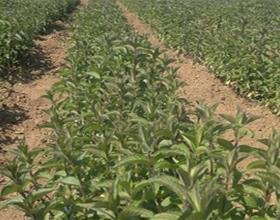
Mint is only a cultivated plant, and its production is found all over the world. The English Mitcham variety is mainly cultivated, but there are also some other varieties.
Morphological and physiological characteristics
Mint is a perennial plant, 30 to 80 cm tall, with branched rosette stems. The body is shrub, the roots are tufted, poorly developed, and in the soil they form the mass of underground stems from which a very large number of above-ground stems develop. Later, the underground stalks are used for planting mint (mainly in autumn).
The leaves of mint have short, longitudinal elliptical stalks, and their lips are serrated with prominent long veins measuring 4 to 7 cm. The upper surface of the leaves is dark and smooth green, while the underside is bright green.
Mint branches end with flowers composed of 6 to 7 flowers. The flowers are fine and found at the tips of the branches, which branch out from the leaf axils. The flowers are reddish-pink or purple in color.
The plant contains the most essential oil at the beginning of flowering. It blooms from June to September.
Chemical composition and use of the mint plant
Dried mint leaves contain 2-4% essential oil, while herb contains 1-2%. It is widely used in medicine, for the production of teas, for healing digestive and respiratory organs, in cosmetics, pharmacy, and the food industry.
Conditions for success
Climate - It thrives in countries with a humid climate. It has a very wide distribution area and thrives in almost all countries. It has no special heat requirements, but it struggles to withstand low temperatures during the growing season. The above-ground parts are damaged as soon as temperatures drop to 0°C. Mint has a strong preference for light. It can also be cultivated at high temperatures but not above 800 m altitude, as this negatively affects the yield of the mint. It does not tolerate drought because this plant has a well-developed system of underground stems – stolons – and has a poorly developed root system, mostly located on the soil surface.
Soil – It suits sandy, alluvial, and rich soils, while heavy soils are not suitable. It suits soils with low to neutral acidity.
Cultivation
Crop rotation – Mint is continuously cultivated in crop rotation due to its high nutrient requirements and is not resistant to leaf rust. Soils that have been planted with fruit crops are suitable. They remain in the same plot for 3 years, while in the same plot they can be cultivated after 3 to 5 years.
Soil cultivation – The basic tillage of the soil is very important because the soil surface must be loose, as is known to contain underground stalks – stolons. As much water as possible must be ensured and weeds must be removed. These two operations are considered only by taking into account the weak root system. As soon as the preceding crop is harvested, soil cultivation should begin immediately. First, with a light soil layer 15 cm deep, and in autumn with a deep tilling of up to 30 cm. For spring planting, the beds should be left open, while for autumn planting, soil preparation for planting begins immediately.
Fertilization – Fertilization with barn manure is best suited when it is placed in the pre-culture crop. If applied directly before planting, it must be extremely well-burned.
Propagation – carried out in two forms: through stolons and seedlings.
Stollons are taken from plots that have been previously designated for this purpose. The best propagating material is obtained from mint plants from annual crops. During the planned preparation of propagation material, it is best to select plants that are more developed and those that do not have rust on their leaves. Selected stollons taken from these plants must be propagated in a separate plot. The amount of seedling material taken from this plot can be used to expand the area by 3 to 5 times for a larger area. It is known that stollons develop both below and above the soil surface. Those that develop on the surface must be removed because they are infected with rust spores and can serve as a source of infection for the seedlings. Stollons should be taken out directly before planting and must not be exposed to winds or sunlight. If imported from afar, it is best to place them on a straw mattress, which should always be kept moist.
Seedling planting – It is done in autumn or spring in both cases as early as possible and must not be planted in dry soil. Autumn planting can begin in the second half of September, but this month often has no rainfall, so planting should be done in October or November. Autumn planting has many advantages compared to spring planting. Stollons that remain during winter are subjected to extremely low winter temperatures, are completely damaged, and nothing remains to be used in spring as seedling material. Material planted in autumn begins to recover from damage during seedling preparation and planting, and with the arrival of high temperatures, they start to develop. Autumn planting has the advantage of being harvested earlier the following year. The stollons are covered with soil up to 10 cm deep and withstand temperatures down to -10°C.
Peppermint planting is done in such a way that in the soil well prepared for planting, a 10 cm diameter diameter is opened. The distance between the holes should be 60–70 cm to prevent excessive moisture loss. The opening of the holes should be done immediately before planting the seedlings. The stolons are placed lengthwise along the hole and are covered immediately once installed. If planting is done in spring, the activities will be the same, except that cylindrical drilling must be done to prevent moisture from escaping from the trunk, because spring winds dry out the soil very quickly.
About 1,500 kg of stollons are needed for planting 1 hectare.
Care
During mint cultivation, the following agrotechnical care measures are applied: mowing, feeding, weeding, irrigation, and pest protection.
Tillage – is a mandatory measure. The number of times it is applied depends on the characteristics of the soil, weeds, weather conditions, etc. If the soil quickly forms a crust and is quickly covered by weeds, then it must be plowed and cultivated several times between rows. After each irrigation, cultivation should be done between rows, while harrowing is usually done twice. These operations are carried out until the stollons cover the space between rows. A hilling is done immediately after planting and irrigation.
Hoeing – If 3 to 4 weeds are done during the growing season, then weeding is often not necessary. Before self-harvesting, when the space between rows in mint is covered with weeds, it is advisable to weed them first. The presence of weeds will negatively affect both drying and the quality of the extracted essential oil.
Irrigation – for mint should be done where possible. During long dry periods, watering is mandatory, at least twice, and several times depending on vegetation needs. After the first mowing, watering is necessary. Irrigation in the form of rain is best suited for it, and this should be done late in the afternoon and with delays during the night.
Diseases and pests - Among fungal diseases, peppermint is most commonly attacked by rust (Puccinia menthae). This disease manifests as rust-colored spots appearing on the underside of the leaf. The disease first attacks the lower leaves near the ground and then spreads from the tip. The lower leaves slowly darken and begin to fall off. Partially diseased leaves have no commercial value even as raw material for distillation. This disease appears shortly before flowering, so mowing can prevent the spread of the disease and eliminate any potential losses. However, if reported earlier, then technological ripening should not be expected. During the period when the disease is known to appear, the plot planted with mint should be inspected daily because the disease spreads very quickly. Rust completely destroys the mentholed plots within a few days, so as soon as the first symptoms of the disease appear, spraying should be carried out. Pests are attacked by lice, etc.
Mowing - Done when the flowers open at one-third of the flowering stage. At this stage, the leaves contain mostly essential oils, while mint produces the most mass. Peppermint mowing is done by machine, but if production is lower, hand mowing is also possible. Mowing is done only 5 cm above the soil surface, which should be done during dry periods. If the mint plant is wet from rain and frost, the leaves quickly turn black and begin to rot. When the leaves on mint dry out, they no longer have a beautiful green color, thus losing their commercial value. For obtaining the dry plant – the drug, harvesting must start earlier and only as much as can be dried and the leaves removed within a day as prescribed by the rules.
Drying – what it is used for depends on the market and processing possibilities. To obtain the mint leaf, the mowed plant is left in the mowed spot for at least 3-5 hours, to dry a little, after which it is moved for further drying, which can be done naturally or through a heat dryer. Drying should be done in shaded spaces but with good air circulation. The leaves or the entire above-ground part of the plant should be spread out in thin layers. During summer, when there is no rainfall, the drying process lasts 4-6 days. However, with the drop in temperatures and the increase in air humidity, the drying period extends up to 10 days or more. However, for drying, porches, corn bins, ceilings, etc., can also be used, which are inexpensive during mowing but must be well cleaned. The plants are placed in wire-woven stalks. The leaves and mint plant can also be dried in a dryer. In the first 3 hours, the temperature should be 50-55°C, then the temperatures are lowered from 40-45°C, and in this drying method, the highest quality of the product (mint) increases.
The removal of leaves from the stems can be done in several ways using nets or ordinary shaking. Today, there are machines that break the leaves and then remove them from the stem mass by air. Finally, the mint plant must be completely dry, clean, without any additions from other plants, naturally green, with leaves without spots, not with leaves that have turned black.
To obtain one kg of dried plants, 4 kg of fresh mint material is needed, whereas for leaves, then for 1 kg of fresh material 5 kg is needed.
Packaging and storage – dried mint leaves should not be stored for long because they are very hygroscopic and thus absorb moisture. Moist leaves easily lose their green color. The dried plant should be packed in multi-layer paper bags. The dried mass is stored in cool, dried, and dark places.
Yields – Mint yields 1,500 – 2,000 kg of dried leaves. The yield of the above-ground part of the plant is 3,000 – 5,000 kg/ha. For one hectare of cultivated mint, 25–40 kg of essential oil is extracted.
Peppermint is mainly cultivated for its leaves (Mentha piperitae folium) and leafy stems (Mentha piperitae herba), specifically for its essential oil (Mentha piperitae aetheroleum). The plant contains about 1.25% essential oil, of which 50 to 90% is menthol and 5 to 20% menthol. Essential oil is obtained by extracting only the leaves from above-ground mass or from mint.
The wild mint type – Mentha arvensis and others are used as tea either separately or mixed with chamomile against headaches, stomach difficulties, insomnia, fatigue, and colds.
Today, wild mint is used in the production of brandy, chocolates, cakes, chewing gum, and more.
In medicine, menthol has been proven to be a good remedy for: stomach diseases (irritations and stomach upsets), respiratory organ diseases (mouth, throat, and cough), nervousness, gallbladder diseases, intestinal diseases, liver diseases, etc.
Available in: SHQ, ENG, SRB