
|
Climatic conditions |
Amount of water per plant (liter) |
|
Time with lots of clouds |
0.14-0.28 |
|
Cloudy for most of the day |
0.28-0.42 |
|
With relative clouds |
0.71-0.85 |
|
Sunny with slight variations |
1.1-1.2 |
|
With sunshine |
1.5-1.8 |
Nutrition - To ensure high and quality productivity, it is necessary that plants have sufficient amounts of nutrients around the root zone, which are easily utilized. Tomatoes respond differently to a number of nutrients, but depending on their dose, the plant exhibits different behaviors related to vegetation/reproduction ratio, the speed of transition through different phenological stages, susceptibility to diseases and pests, or the speed of onset of various physiological disorders.
Reaction to nitrogen - As nitrogen doses increase, plant vitality usually also improves, such as their height, number of leaves, and the number of flowers formed. Similarly, plant production increases in parallel with the increase in nitrogen doses, as they remain at moderate levels. However, very high doses of nitrogen reduce the production achieved by plants. It is clear that plants' reaction to nitrogen does not depend only on the dose at which it is used, but also on the nitrogen content in the soil and the intensity of its mobilization, mineralization, or denitrification during the plant's life cycle.
Reaction to calcium and magnesium - Calcium deficiency reduces plant height and the number of formed leaves, while magnesium deficiency decreases plant growth and production. Adding magnesium to the soil improves the shape and quality of the fruits. Meanwhile, magnesium deficiency is one of the most common nutritional disorders in tomatoes. This phenomenon occurs most often under conditions of abundant nitrogen and potassium fertilization. For example, production losses due to magnesium deficiency can reach 5% under low-dose nitrogen fertilization but increase up to 10% if nitrogen doses are high.
Tomato fertilization techniques in greenhouses - To determine the plants' fertilizer needs, soil analyses are first conducted, which are taken at least once a year before the base fertilization. Meanwhile, particular importance in determining the daily fertilization doses is knowing the daily rates of assimilation of key nutrients by the plants, as this fact allows for determining the daily doses of fertilizers to be used to supplement them, as well as the ratios between the main nutrient elements at different stages of plant development. Tomato fertilization in greenhouses is carried out through the following fertilization methods: a) Basic fertilization, companion fertilization, and supplementary fertilization.
a) Basic fertilization of plants - It is done with organic and mineral fertilizers, aiming for the soil at the time of planting to have a pH of 6-6.5, sufficient phosphorus reserves throughout the entire growth cycle, a sufficient amount of nitrogen for the first growth phase but not in excess, as it stimulates excessive plant growth. Also, this fertilization ensures sufficient potassium reserves, which guarantee good fruit quality in the early stages of production.
The amount of fertilizers that can be used in base fertilization depends on the fertility of the soil. The distribution of base fertilizers is carried out before soil tillage (organic fertilizers and some of those containing phosphorus and potassium) and before the final preparatory tillage of the planting bed. With the latter, pesticides necessary for disinfecting the soil from fungal diseases, or for controlling soil insects and nematodes can also be applied.
|
Soil fertility level |
Recommended amounts (kg active ingredient/100 m²) |
|||
|
N |
P |
K |
mg |
|
|
Low |
3.5 |
2.5 |
5.5 |
2.8 |
|
Average |
2.8 |
1.5 |
4.4 |
2.0 |
|
High |
2.0 |
0.5 |
3.2 |
1.2 |
|
Very high |
1.2 |
0 |
1.9 |
0.4 |
The following table presents the indicative rates for supplementary fertilization of tomatoes in greenhouses, expressed in kg/day/1000 m²:
|
Phenological phase |
N |
P2O5 |
K2O |
|
Transplanting - the first flower |
0.10 |
0.10 |
0.10 |
|
The first flower - flower formation 5 |
0.20-0.40 |
0.12-0.24 |
0.30-0.50 |
|
The fifth flower - the beginning of the harvest |
0.50-0.80 |
0.30-0.50 |
0.75-1.20 |
|
Harvest period |
0.60-0.80 |
0.40-0.45 |
0.90-1.20 |
|
6 weeks before the last harvest |
0.20-0.30 |
0.12-0.18 |
0.30-0.45 |
With the proportional method, the concentration of fertilizers in the nutrient solution is adjusted throughout the entire fertilization period. In this case, venturi injectors or hydraulic pumps are used to mix fertilizers with water. The proportional method allows full control of fertilizer concentration in the soil, making it highly recommended in light and sandy soils, poor soils with low absorption capacity. The recommended concentrations of fertilizers with this method are 0.1-0.2 g/liter in the first weeks after transplantation and 0.3-0.5 g/liter during the later stages. If fertilization is applied once every 2 or 3 waterings, the fertilizer concentration increases by the same amount, but with continuous attention paid to avoiding salinization in the soil.
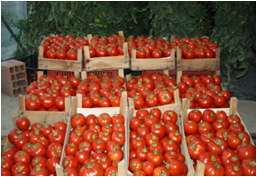
Harvesting tomato fruits - The ripening time of tomato fruits mainly depends on the air temperature and the position on the rooster. Raising the air temperature (within optimal limits) accelerates the ripening of the tomato. Fruits in the last flowering position have a longer growing period than the first fruits. The average growth period of tomato fruits is 45-60 days.
Optimal conditions for storing/preserving tomato fruits for 3-4 weeks, in the refrigerator and cooling environments, should ensure a temperature of -1 to +1 °C and relative air humidity of 90%.
It should be mentioned that vegetable fruits continue their vital functions even after harvesting (respiration, ripening), so due to the loss of heat and water, drying, wilting, rotting, changes in taste, aroma, and color occur. These factors must be taken into account when planning transport and the contracted quantity that must reach the market.
During the sorting and packaging of fresh vegetables, the main principles can be the general rules for placing vegetables into circulation (marketing), which require these six (6) main conditions to be met: 1) the vegetable fruits must be ripe and fresh, 2) they must not be contaminated, 3) they must not be wet or rotten, 4) they must not contain residues from plant protection products in amounts that could be harmful to health, 5) they must not have an unknown and indetectable smell or taste and must not contain mechanical mixtures, 6) they must not have cracks, holes, insect damage, diseases, freezing, or other mechanical damages, nor other deficiencies that could worsen quality
Available in: SHQ, ENG, SRB