
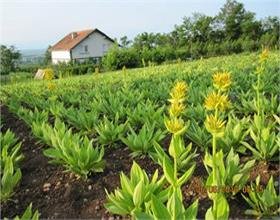
It is believed that the name Gentiana derives from the name of the Illyrian king who, in the 2nd century BC, revealed the healing properties of this plant. The use of Gentian for medicinal purposes has not declined to this day. It is found in the mountains and meadows of the mountains of Southern, Southeastern, and Asia Minor. Due to uncontrolled exploitation, this species is very rare, but its extinction is increasingly occurring. For this reason, research into the possibilities of cultivating this plant species began in Europe several decades ago.
Morphological and physiological characteristics
Gentiana is a perennial green plant. It is characterized by exceptionally fleshy roots, few or many branched. In dry conditions, the roots are folded with ring-shaped folds, brown on the outside, while yellow on the inside, with a strong smell and a very bitter taste. On the root head, there are 5-10 buds from which new leaves or flower trunks develop each year. Young plants (aged 3-4 years) develop only a rosette of leaves. The leaves are large, elliptical, with a pronounced neuration. On the leaf, 5-7 parallel veins are observed. The flower trunk develops only in the 4th or 5th year of the plant's age. The trunk is vertical, not branched, hollow, and reaches a height of over 1.5 m. The leaves on the trunk are much smaller and are spread. The flowers are golden yellow in color and gathered in clusters in the form of protective glands arranged at the nodes of the trunks, specifically in the leaf axils. The fruit is a capsule containing up to 100 seeds. The seed is much more extended, close to the kernel, which gives it the appearance of wings. The seed coat represents 18-20% of the seed. The weight of 1000 seeds collected from self-germinating plants in our country is 0.82-0.88 g and can be up to 1.3 g. The seed mass also contains 30% hollow or undeveloped seeds. This information should be taken into account when determining the seed for planting. Seeds germinate very poorly, so before planting, we need to approach them in a special way. For more, see photos in Annex 1.
Chemical composition and use of the Gentian plant
The Gentiana root, as the part used, contains bitter glycosides (gentiopricorn 2-3.5%, amarogencin 0.15-0.20%).
These substances give the root a strong bitter taste. In addition to these, the roots also contain amarosverin, amarophan, xanthonic derivatives (which give the roots a yellow color), some pyridine alkaloids, etc. The roots are used as bitter substances to strengthen the body, improve appetite in digestive organ diseases, and are also used against anemia.
A greater number of various preparations for medical needs are produced from Gentiana's roots; liquid extracts, tinctures, healing wines, etc. However, the largest quantities of Gentiana roots are consumed in alcoholic beverage products.
Conditions for success
Climate - Gentiana grows only in mountainous regions. In Kosovo, it grows in the Sharri Mountains, Nemuna, Shalë of Bajgora, etc. It thrives at altitudes of 800 – 2500 m. The shrub itself grows in the structural soils of meadows and mountain pastures, as well as in coniferous regions.
In some mountain regions, due to uncontrolled exploitation, it can only be found in places where access is impossible, that is, only where irresponsible harvesters have not been able to offer it.
Soil - For cultivation, it should be deep, without a framework, good aerial capacity, and good permeability to water. It is recommended that the pH should not exceed 6.5. Mountainous regions above 1,100 m.l.m seem to positively influence the production of bitter substances, so the root of Gentian from these altitudes contains more than 50% amarogentin than the root of Gentian from an altitude of 450 m above sea level. In principle, it requires cold (cool) settlements.
Cultivation
Crop rotation – Gentiana is cultivated as a perennial crop. The production cycle most often lasts 5 years. For this reason, it should be planted after those crops that keep the soil free from weeds. Cereals are suitable as a pre-crop.
Soil cultivation - Since the crop remains in the plot for 5 years, deep tillage of the soil before planting Gentiana is necessary. The basic soil tillage must be done on top of any other cultivated crop. If planting is done in autumn, then tillage should be done at full depths, immediately after clearing the plot of previous crops. Preparation before planting must also be done immediately. If planting is done in spring, the cultivated soil remains in open furrows to overwinter.
Propagation - Gentiana is propagated by seed, specifically through seedling production. Due to the presence of dormancy, Gentiana seeds must definitely undergo seed preparation procedures. There are many known ways to stop seed dormancy in this species.
Keep the seeds moist at around 2°C for 10 weeks (70-75 days). After this period, the seeds are ready for planting.
The seed substrate in the container is placed outdoors in January during winter under the influence of snowfall until April. Planting in open fields also comes into play. The plants sprout during spring and develop throughout the year, while they are ready for transplanting in autumn or the following spring.
Treatment of the seed with the dissolution of gibberellic acid, at a concentration of 200 ppm, for 24 hours, after which the seed is ready for sowing.
Seed sowing - prepared is done in a tray or container depending on the type of production. The seed is covered with a thin layer of substrate – a few millimeters. The best germination is at a temperature of 18 – 20°C. Germination under these conditions begins 10 – 14 days, after which the optimal temperatures for development are 18°C during the day and 12°C at night. Within three months, the plants reach the stage in which they can transplant to a permanent location. This is usually done in early autumn or the following spring. Since the seedlings obtained this way are very small and the plots for production often have a high composition of weeds, seedlings can be left open for another year in open plantings, but in such situations, they must be provided with sufficient vegetative space.
Transplanting in the plot is done at a row distance that allows mechanized work between rows, and this is mostly 50-70 cm. The distance between plants in a row should be about 20 cm, which ensures 700-1000 plants in order. Good plant compatibility ensures a high yield and is very important for the overall efficiency of production.
Care
Cultivation between rows and mowing are regular care measures carried out as needed, primarily depending on the appearance of weeds. In the first years, they are done 3-5 times a year since we are dealing with very sensitive plants that grow slowly, and if their vegetative space is not cleared from weeds, production slows down significantly.
Watering Gentian is almost necessary regularly during the first year after transplantation. At that time, the root is very shallowly set, and any lack of moisture is insufficiently expressed in growth and development. In later years, irrigation is necessary during the onset of long dry periods.
Harvesting - The Gentian root is harvested in the fifth year of the growing season, in spring if used for pharmacological purposes, and in autumn if used in the liqueur – alcoholic beverage industry. The root is extracted with a single plough without reed or mechanized cultivation is used to extract other root crops. The root is cleaned of soil and washed with water.
Drying - The fresh root is cut into rings and dried in a dryer at 60°C within 24 hours. The dry root is immediately packaged because it easily succumbs to absorbing moisture. If the production is intended for liqueur production, root drying is not necessary.
Yield - At cultivation densities of 100,000 plants per hectare, the yield of fresh root ranges between 24-40 t/ha, which after drying corresponds to a yield of 5–8 tons. At sparse density (about 50,000 plants per hectare), the yield is about 12–15 t/ha of fresh roots.
Available in: SHQ, ENG, SRB