
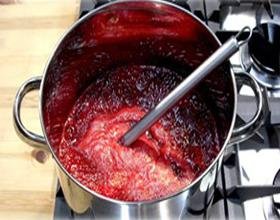
Most recipes only emphasize 'cook until the jam is ready to be tasted or tested.' Experts who prepare jam know exactly what this saying means: place a small spoonful of prepared jam on a small cold plate (which has been kept in the refrigerator), let it cool for one minute, then place your finger to see if the point is reached when the jam is ready. Using a thermometer: jam and jam determine the moment immediately after being boiled at 105C/220 F for 10 to 15 minutes.
HOW MUCH JAM IS PREPARED IN EACH RECIPE?
This is a good question and it needs to be answered. Many people want to know the right number of jars for storage, or the exact number of jars they can get for storage, etc. The amount of jam for each given recipe will vary based on the moisture content and ripeness of the fruit used. Even the correct recipe can produce more or less usable jam on different days, from different suppliers of the same fruits. As a guide, 1.5 kg of fruit with 1.5 kg of sugar and 250 ml of water usually ends with the benefit of 2 liters of jam (give or take) after boiling and reaches the timing of the moment. The best thing to do is to have a sufficient quantity of jars and lids so that you can be sure you have coverage.
CAN JAMIN BE MADE WITH LESS SUGAR?
This is a common concern (issue) nowadays; many people want to prepare jam with little sugar, reducing calories and insulin that affect the preservation feature. The answer is YES, but using less sugar than what is written in the recipe means you cannot store jam for a long time, and once opened, it should be kept in the refrigerator to prevent mold development. If you are concerned about the amount of sugar in jam, then maybe you should make fruit compote or preserve it better.
IS JAM'S TRAINING DANGEROUS?
If we start preparing jam the wrong way, with the wrong equipment and rushing, then jam preparation can become very dangerous. A repeated boiling, which can reach a temperature of about 200 °C, produces a very thick liquid, which, if it comes into contact with the skin, can be very dangerous. However, there is hardly any risk if you spend your time the right way, using a deep storage pot (or pan) only half-filled, a long hand spoon for stirring, and a jam funnel for emptying the jam.
And although fruit picking is a good family day, it is not recommended for us to make jam with the help of young children; in fact, it is much better for concentration if you do it yourself continuously.
CAN I USE MY OLD PAN TO PREPARE JAM?

WHAT IS THE BIGGEST PROBLEM IN PREPARING JAM?
Clutter. Clearly and simply: if you overfill the canning pan (or if it's not large enough/tall enough), then during mixing the jam can splash over the entire cooking surface, which when dry, can be difficult to clean. And if you are confident or rushing when filling jams into jars, you might accidentally splash them everywhere; for this reason, it's good to put newspapers underneath and keep an old cloth in hand. If you are prepared and not in a hurry, most of the mess can be eliminated.
I HAVE PREPARED LIQUID JAM, SHOULD I THROW IT AWAY?
Available in: SHQ, ENG, SRB