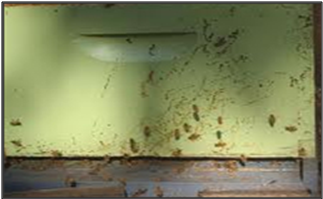
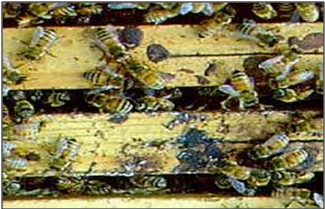
Nozemoza disease, caused by the protozoan nozema apis, usually affects adult bees. Under favorable conditions, the parasite develops very quickly. Meanwhile, in the external environment, such as in soil, the parasite forms spores that can live for 2-4 months. Infection is transmitted through spores, which can be achieved through food; contamination of water sources and bee droppings can also be a source of this disease. Worker bees also spread the disease because they are always on the move. But it can also easily spread from careless beekeepers who do not disinfect tools and work clothes. Infected or sick bees consume food continuously, and in the back intestine, the accumulation of infected feces with spores occurs, and if temperatures are low, contamination of the frames and walls of the enclosure occurs.
Bees often lick the feces infected with spores, thus spreading the disease, which usually appears at the end of winter and bees die around the end of April and the beginning of May.
Symptoms of this disease: they are usually observed in old bees, which are not very active, live much shorter lives, while infected queens lay fewer eggs and lay them irregularly, causing the company to gradually shrink and eventually die.
A long and cold winter favors this disease, as do instant honey, cool summer, and so on. Also, when there is a severe infection during winter, the symptoms of the disease are very easily noticed in early spring because the bees contaminate the hive with feces on both the inside and outside as well as the frames. But diagnosis is also done by experts in laboratories, where they check 20-30 bees from each colony.
Measures for the prevention and treatment of the disease
Initially, measures are taken to prevent the spread of the disease, disinfected tools are used, and the wax and infected combs are thawed. Infected bees are placed in new hives, and the old ones must necessarily be disinfected with caustic soda containing 4%, or it can also be carefully done with flamethrowers. It is important to know that this disease is fought based on the law on animal protection from infectious diseases that pose a risk to the entire country.
Nozemoza disease is fought with preparations such as Nesocid, Fumicidil B, Fumagillin DCH, and other drugs under different names depending on the manufacturer.
If we use the preparation Fumagillin, for 10 meals a dose of 20 grams is needed, and initially this amount is dissolved with a little water, then strained and mixed with 25 liters of warm syrup, and this food solution is placed in the food tray. Healing can take 2-3 weeks.
If a preparation called Nezocid is used, it can also be administered with water and food. For water disinfection, 100 ml is used in 25 liters of water, while for disinfecting combs, 100 ml in 10 liters of water, and this solution is sprayed on the frames regardless of whether there are bees or larvae. Treatment of a colony can be done with 200 ml of solution, and 5 treatments can be done at intervals of 5 days.

 Nozemoza disease, caused by the protozoan nozema apis, usually affects adult bees. Under favorable conditions, the parasite develops very quickly. Meanwhile, in the external environment, such as in soil, the parasite forms spores that can live for 2-4 months.