
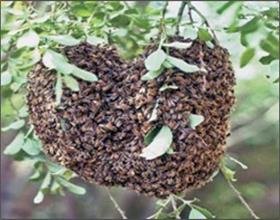
Beekeeping is an inherited biological phenomenon where bees reproduce, as some of the worker bees, a few males, and the old queen separate and settle in a new hive.
Bee swarming is a negative phenomenon, so it must be prevented in various ways by expanding the hive with empty combs, wax sheets, or layered hives until the doors are fully open.
If there are many honey frames in the hive or hive, they can be removed and replaced with frames with built or new combs.
Also, during this activity, mothers should be eliminated, while old mothers should be replaced with new ones.
But if there are more sealed larvae in the hive or hive, enough grazing, and if the weather is good, then the family can still roam.
It has been proven that during the swarming period, the activity of the colonies drops rapidly; the worker bees collect less food, do not produce wax, and also do not build brood. At this time, the worker bees feed the queen less, who lays fewer eggs, increase the number of unfertilized eggs, and the worker bees form queens, leading to the formation of a bee colony that does not engage in any family activity. The bees prepared for swarming gather at the door or on the veranda of the hive and form a "beard."
The departure of the guard

The family is ready for breeding when the first mothers are sealed and the queens are about to leave.
The first guard leaves between 10:00 and 14:00 on the day, when the bees initially fill the sac with honey, then half of the guard bees come out, then the queen leaves, and finally the other half of the bees prepared for swarming also come out.
The guard consists of 15.000-25.000 worker bees, several hundred males, and the old pregnant queen.
The guard has the shape of a kalavesh, and in the middle is placed the queen, where the bees stand firmly against each other.
Then a group of bees separates from the guard and seeks a new shelter.
Once identified, the bees prepare their habitat, which some guard while others return and notify the guard by special waves, who flies quickly and settles into a new hive.
Once identified, the bees prepare their habitat, which some guard while others return and notify the guard by special waves, who flies quickly and settles into a new hive.
These voices are answered by the other mothers within the mothers (kua, kua, kua), and they are clearly distinguished from the voice of the mother who has come out. The faint voices are repeated, and from this song it is understood that the family will roam the next day. The second guardian comes out with a new mother.
And after 1 or 2 days following the second swarm, the family may lay a third litter. The second guard and the others are weaker, have an infertile queen, and often mate or return to the old brood.

Swarming has both positive and negative qualities
A positive trait is that the number of bee colonies increases, while a new queen forms in the old colony. This colony becomes much stronger because the new queen lays more eggs.
A negative trait is considered to be that the family reduces all activities 15 days before sawning, collects less food, the mother lays fewer eggs, and the honey yield also drops.
Share
Available in: SHQ, ENG, SRB