
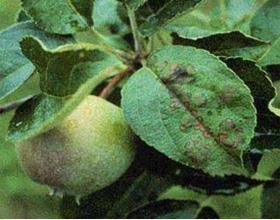
After continuous monitoring through the meteorological station located in the village of Vaganicë, municipality of Mitrovica, we have signals that on May 7 we have a mild infection from Molla Scab. We can also see this through the report and the graffiti extracted from the data from meteorological stations.
Recommendations for fruit growers
We recommend spraying trees to protect against Apple Scab (Venturija inaequalis) immediately after rainfall.
Preparations for the protection of Apple Scab (Venturia inaequalis)
| Disease | Preparations | Active matter | Dose/Concentration |
Apple Scab (Venturia inaequalis) |
Chorus 75 WG | cyprodinil | 0.2-0.3 kg/ha |
| Score 250 EC | 250 gr/l Difeconazole | 0.2-0.3 L/ha | |
| Zato 50 WG | trifloxystrobin | 100-150 gr/ha | |
| Flint Plus | trifloxystrobin + captan | 1.25-1.85kg/ha | |
| Clarinet | Pyrimetanil + flukviconazole | 0.1-0.15% | |
| Punch 10 EW | Flusilozole 10% | 0.2-0.3% | |
| Antracol WP-70 | propineb | 0.2% |
Description of the disease
It is one of the diseases most commonly found on apples, on leaves, flowers, fruits, but also on seedlings. The most dangerous period is before and during flowering, as well as during fruit formation. The initial infection period can be predicted by collecting data during the moisture period, the duration of humidity, and temperature changes during this time. The possibility of disease occurrence occurs when the average temperature during the wet period is 13 °C and the duration is 11 hours.
Damagecaused
The greatest damage caused by the fungus occurs in cool, humid weather, whereas it does not appear in places with hot and dry climates. The disease affects the quality and size of the fruits, as well as the duration of their storage in the warehouse. On the leaves, the damage manifests as black and round spots (irregular round shape), while the flowers are almost burned. Young fruits, if affected by scab, fall from the tree, while fruits grown with disease spots do not fall to the ground but lose their commercial value.
The disease reduces fruit yield and fruit size, as well as causes cracking and fruit deformity. Infected fruits have lesions ranging from dark brown to black in color, which are not favorable for the market.
The pest development cycle
The fungus overwinters in the soil, usually on fallen leaves, buds, and trunks. This disease can also appear when the fruits are grown, especially if there is rain during the summer.
The fungus also overwinters on fallen leaves (which remain in the soil). Ascospores cause the primary infection in spring during humid weather at temperatures of 6-26 °C, which are released from the leaves from the ground when they get wet (moist) during early spring rains.
The mycelium of these fungi develops beneath the cuticle and forms short holding conidia with unicellular conidia. During the relative dormancy phase, generative organs of the pathogen form on the fallen leaves – perithecies with ascetics and ascospores. Depending on moisture, secondary infections recur several times during the growing season.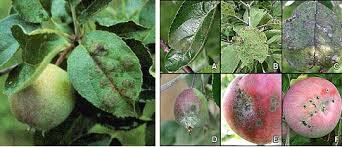
Photo Symptoms and damage caused by Apple Scab
Available in: SHQ, ENG, SRB