
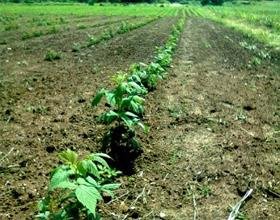
Caring for the raspberry orchard in the first year after planting includes: regular soil cultivation, weed control, fertilization, pomotechnics, watering 3-4 times, and protection against disease pathogens and pests. Regarding pomotechnics, in the first year after planting, the part of the seedling that remains 20 cm above the soil surface should be removed once the new shoots have formed and reached a height of 25 cm.
If the old part of the seedling is not removed, then during the growing season it will develop and produce fruit; it is biennial, but such development harms the new shoots that should form that year and produce fruit the following year. In this case, they will become deformed and do not develop sufficiently. At the end of the growing season, the old part of the seedling dries out. If the new shoots that bear fruit in the following year have not developed, raspberry production in this case can be compromised.


During the growing season, the new shoots develop, covering the entire space in a row. Since the new shoots are flexible and extend to the ground, to keep them vertical, they are inserted between wire strands and tied with a rope.


Each left shoot is shortened with an inclined cut above the bud at a height of 1.8 – 2.0 m from the ground, or practically from that height where above the last wire there are four buds, meaning there are 24 buds along the entire length of the shoot. This raspberry operation is performed in spring. After pruning, a shallow hilling is done in a grater with raspberry cultivation.


At the beginning of the growing season, during the years of use, new shoots continuously grow from the growth point from the root, with the first series always removed down to the soil surface level, in order to stimulate new growth and control the habitus of the above-ground system. However, the question arises: until when should these growths be eliminated? Such timing is determined by the fruit growers themselves in their orchards according to conditions, but there is also a rule that the best shoots to be preserved for the following year are those that grow up to 1 meter in height that year (the time when they have passed the first level of the wire) at the time of fruit harvest on two-year-old shoots.
In practice, this time should be May 15th. However, the best operations to perform are these: all shoots that appear by May 15th are removed, and after this time, they are left to stay. If the young shoots do not reach the first layer of the wire at harvest time, the removal of the new shoots is done two days earlier, on May 13th. After harvesting, the two-year-old shoots begin to dry out from the tip towards the base, so these are completely removed. Such shoots remain in the orchard for several dozen days after cutting, serving as shelter for the young shoots which, if exposed directly to sunlight, can develop burn spots. After this period, the new shoots along with the old shoots are again removed and burned so they do not become a source of infection.
Available in: SHQ, ENG, SRB