
Symptoms
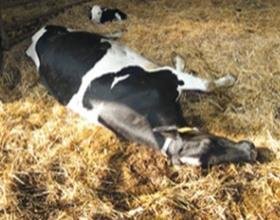
Cows with puerperal paresis have loss of appetite and the digestive tract is inactive. The cow is unsteady when walking and, in larger cases, lies down with its head turned to one side and unable to stand up or calve; often, in this position, swelling of the cow can occur. The cow does not respond, the ears are cold, and the nasal discharge is dry.
The cause
Puerperal paresis is thought to result from the immediate increase in calcium demand for colostrum or milk production after calving. Calcium requirements increase two to three times in a very short period. During this period, the cow cannot change its metabolism quickly enough to mobilize the sufficient amount of calcium from its body's reserves. Cows have a mechanism built to facilitate the mobilization of calcium from their body reserves, but sometimes these are insufficient.
In order to meet calcium requirements and absorb calcium from the intestines, supplemental calcium must be increased and calcium mobilization from the skeleton must occur.
This is explained by the fact that all cows in breeding have low levels of calcium in their blood. If the cow does not respond quickly to the high calcium requirements, signs of puerperal paresis will appear. It has recently been discovered that a low magnesium level in a ration limits the ability to absorb calcium. This can happen in pastures with low magnesium levels when dairy cows are on pasture.
Treatment
Treatment of puerperal paresis means restoring the normal calcium level in the blood. The most effective method is still intravenous injection of calcium solution followed by oral administration of diluted calcium powder after a few hours, and then repeated again after 6 hours.
Calcium solution is the standard treatment. The results of intravenous calcium administration in most cases are noticed immediately. If no effects are observed after treatment, caution should be exercised if the cow has any other disease such as mastitis. If the cow is unable to lift, treatment should always include the cow's lift aid and turning it from one side to the other at intervals of every hour to avoid swelling.
A lying cow always requires frequent supervision and good care until it fully recovers.
Prevention
Available in: SHQ, ENG, SRB