

Root collar – the connecting part between the root canal and the above-ground root
The trunk – the part from the Q of the root to the first branch, which can be long (60; 60-100; over 100 cm)
Central leader – the branched part of the tree from the trunk to the continuation of the central U.
The Central Leader's Successor – the part that leads the growth of Central West
Branches: Skeletal (primary, secondary, tertiary), Auricles (branches of the fourth order and onwards: short branches (3-6 cm, at 90° angle), thin branches (10-25 cm), thorn twigs (shredded years, 2-3cm), mixed branches (2-3 years old), woody branches (50-60 cm serve for crown formation), suckers (develop from dormant buds), bread-like branches (3-6 cm, have 4-7 fruit buds, live up to 30 years)
Bud – Vegetative (active, dormant, adventive) (apical, terminal), (woody, leafy), Generative (flower) (simple, compound)
Understanding development cycles
- Life cycle – Embryonic phase (from flower fertilization to seed germination), Youth phase (vegetative), Maturity phase (fruit-bearing), Aging phase
- Annual Cycle – Vegetation Phase and Mandatory Dormancy Phase
Crown shapes
- Freeform
- Semi-conducted – improved pyramid, improved vase
- Conducted – Pyramidal, vase, palm tree, pointed hemp, throwing pole, vertical axis, ballerina, hajtek, V system, double shaft, etc.
Characteristics of cultivars
- Canadian rennet – branches at angles of 10° to 70° form fruit buds
- Starcrimson – branches at angles 00° to 80° form fruit buds
- Golden Delisheci – branches at an angle of 30° to 120° form fruit buds
- Gala – branches at an angle of 45° to 100° form fruit buds
- Greny Smith – branches at angles 70° – 180° form fruit buds
Knowing the timing of pruning
- Winter pruning
- Green pruning
Winter pruning
It is applied during the tree's natural dormancy period; it is best to apply it after the aeration period (when the tree is subjected to very low temperatures), February – March.
Tools - adequate and clean (disinfected from time to time with 90% alcohol)
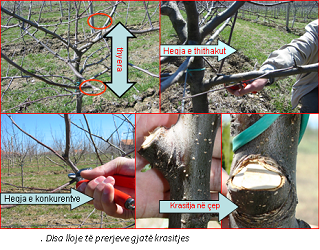
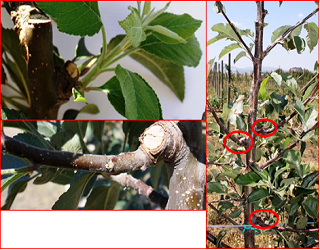
- Creating the vision – cultivation system, shape, competition, lighting, flower loads
- Removal of diseased, infected, and broken parts
- One-year-old shoots are completely removed from the tree canopy or remain untouched, except when there is insufficient growth and we want to stimulate growth through pruning
- Old twigs or two-year-old shoots are thinned or cut off.
- The skeletal branches are maintained at a height that corresponds to the designed crown system by removing strong shoots from the tips of these branches (competitors or brooms)
- Rival branches and branches to the central leader are shortened in the corner
- Ringing the bare parts of the central leader onto dormant buds or poorly developed branches (March – May)
- Removal of cut parts from the orchard
Available in: SHQ, ENG, SRB