

In the last 10 days of April, there has been rain almost every day throughout the territory of the Republic of Kosovo. In most cases, the rains have had a positive effect on increasing water reserves in the land as well as in irrigation basins, but in some areas there have also been floods that damaged agricultural crops. In some parts of Kosovo where there have been floods, there are large amounts of water that have not yet drained from the soil surface; in these cases, water drainage must be done.
However, these rainfall conditions create favorable conditions for the development of diseases and harmful insects.
Temperatures during the first 10 days of May will rise, creating suitable conditions for diseases and pests.
The risks in apple orchards
Apple scab will be favored, and we will have a maximum infection due to the favorable conditions for the development of this disease.
Protective treatments should begin as soon as possible.
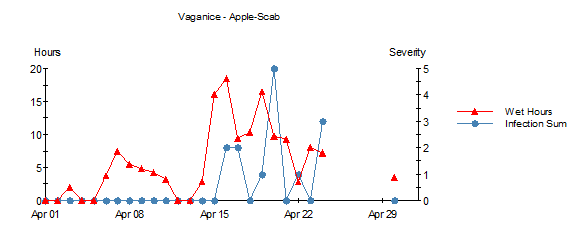
Caution: If we wait for good sunny weather to spray, it is risky because the disease progresses very quickly.
When spraying is delayed, systemic preparations should be used.
In some cultivars, apple ash will also appear. Powdery mildew affects only certain apple cultivars to which they are more sensitive, such as Janatan, Idaredi, and Jonogoldi.
Therefore, only cultivars that showed signs of powdery mildew last year are treated with sulfur products
In some cultivars, powdery mildew or leaf and fruit deformation will also appear. (Dysaphis pentagona). This species is much more dangerous than the green apple blight. If there are affected symptoms, insecticide treatments are necessary.
In orchards where the red spider (Panonychus ulmi) was present last year, treatments with acaricides should be applied.
To learn more about these diseases and pests, see the material described on the website of IADK.
Preparations for combating diseases and pests in apple trees A
| The pest/ the disease | Preparations | Active matter | Dosage / Concentration |
Apple Scab |
Chorus 75 WG | cyprodinil | 0.2-0.3 kg/ha |
| Score 250 EC | 250 gr/l Difeconazole | 0.2-0.3 L/ha | |
| Zato 50 WG | trifloxystrobin | 100-150 gr/ha | |
| Flint Plus | trifloxystrobin + captan | 1.25-1.85kg/ha | |
| Clarinet | Pyrimetanil + flukviconazole | 0.1-0.15% | |
| Antracol WP-70 | propineb | 0.2% | |
| Apple Ash Podosphera leucotricha |
Thiovit Jet 80 WG | 800 gr/kg Sulfur | 0.75-1% |
| Top 100 EC | 100 gr/l Penconazole | 0.4 l/ha | |
| Captan 83 WP | 83% Captan | 0.5% | |
| Anvil 5 SC | 5% Hexaconazole | 30-40 ml/100 L of water | |
| Apple Worm Carpocapsa pomonella | Affirm 095 SG | 9.5 g/kg Emamectin | 0.3% |
| Match 050 EC | 50 gr/l Lufenuron | 0.1 % | |
| Plant lice Aphididae | Actara 240 SC | 240 gr/l Thiamethoxam | 03-0.4% |
| Chess 50 WG | 500 gr/kg Pimetrozine | 0.4-0.6 kg/ha | |
| Scarlet mite Panonychus ulmi | Vertimec 018 EC | 1.8 g/l Abamectin | 0.1% |
| Neoron 50 EC | 50% Bromopropylate | 0.1% |
Available in: SHQ, ENG, SRB