
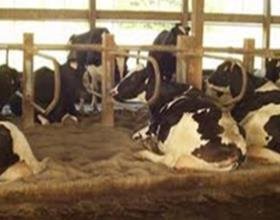
Building the place where the animals stay has a significant impact on the health of the cow and its productivity. A comfortable resting place is essential for the cows because they rest many hours a day.
According to some studies, if the cow area is comfortable and dry, the cow lies down for 10 to 14 hours a day. Barns should provide enough space to allow cows to rise up and fall easily.
A cow naturally rises from a lying position by stretching forward by 60 to 70 centimeters in shifting most of the weight forward to help lift the hind legs. To achieve this natural movement, a cow must have enough space to move its head forward. If it cannot stretch enough, it will be difficult for it to stand on its hind legs. If it is too restricted, the cow will initially stand on its front legs, like a horse, risking damage to the udder. With this in mind, stalls must be well designed and constructed and of appropriate dimensions to prevent injuries to the legs and udder. If the cow's area is short, narrow, and slippery, the cow has great difficulty standing up. The stall shown in the photo is very short, very narrow, very slippery, and has little space to place the cow's neck and head in front, which makes lifting the cow very difficult.

The cow should not be obstructed by the stable or other parts of the barn during the lifting process. If the feeding stalls are high, raising the animals will be more complicated. In such a situation, the cow is unable to move properly forward, so extra space is needed to move its head forward during lifting. Suitable bedding Good bedding materials are essential for the cow's comfort. They contribute to udder health and prevent foot injuries. Moreover, the right bedding has an insulating effect, which helps keep the udder clean and better milking, especially higher quality milk. If a cow weighing 650 kg falls on a cement floor without a bedding, we can imagine the effect it will have on the cow. Therefore, free barns must have enough soft, dry, and clean material. A soft and dry bedding can be achieved using:
• straw, wood shavings, and sawdust - If we use a bedding made of sawdust or any other fine material, it is recommended that the bedding layer be up to 3 cm thick. It is important to keep the bedding clean and dry, and also to ensure that the bedding does not contain dust. The bedding should absorb as much moisture as possible. To prevent damage to bedding materials, they should be stored in places free of moisture. This system requires a bedding of 0.5 – 1 kg per cow per day.
• Rubber bedding - Rubber mats provide good insulation between the cement floor and the cow. Barns with rubber bedding require suitable bedding material for the cow's rest. Rubber bedding must have the following specifications: when the cow is raised or lying down, there must be no slipping, the rubber must have a profiled part to hold the bedding material, be easy to clean, and guarantee for use for at least 10 years.
• mattress for resting - This is a relatively new method for resting cows that has been successfully tested by many farmers worldwide. Beds (mattresses) provide an insulated bedding surface that is natural, elastic, and very suitable for cows during the stretching/sitting process. They prevent collisions, and thus also the risk of injury. The thickness of the mattresses is 8-10 cm; they should be placed on cemented floors to provide a comfortable bedding. Good mattresses contain rubber of uniform size shredded, which maintains natural elasticity. These granules are pressed into tubes, strong, and factory-sewn. The tires are protected in such a way that they
They resist tearing, deformation, or loss of shape. If we understand well the process of lifting and stretching cows, then we will not make mistakes when building barns. These photos show all the stages that cows perform during lifting when they are unobstructed.

Available in: SHQ, ENG, SRB