
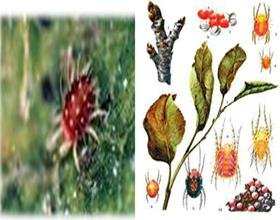
It is widespread in all areas where fruit trees are cultivated worldwide. Even in our country, regardless of the intensity of its infestation, it is widespread throughout the country. It prefers to feed on apple, peach, and plum trees, and less so on pears, cherries, and sour cherries. In certain years, the red spider mite is also widespread in the form of an invasion (over 100 spiders per leaf).
Description of the pest
Females have bodies 0.3-0.5 mm long in an oval shape, dark red in color. On the dorsal side, they have 26 white hairs emerging from warts arranged in seven rows. Males are 0.25-0.35 mm long, green or yellow in color, and almost triangular in shape, with the rear part narrowing. The eggs are 0.15-0.20 mm long, round, red, and have a tail at the tip, like the head of a small onion. Summer eggs are brighter. The larvae are 0.16-0.18 mm long, red, and have three pairs of legs.
Description of the damages

The pest development cycle
The red spider overwinters in the egg stage, usually on two-year-old branches, around buds, and at the site of tree and grapevine branches. In spring, usually in April, larvae develop from the overwintering eggs, which feed on newly formed leaves and develop for 10-15 days, depending on environmental conditions.
In May, adult females feed and copulate, then lay summer eggs which they place on the underside of leaves, usually on both sides of the veins.
In August-September, the last generation lays wintering eggs. It develops 8-10 generations per year, depending on climatic conditions. Warm weather without rain favors the development of the pest. Irrational use of chemical preparations, especially carbaril-based ones (predators also fight them), creates favorable conditions for spider development.
Pest monitoring methods
Pest monitoring begins as early as the winter period by counting the winter eggs, and in this case, if more than 500 eggs are found per meter of shoot length, which is considered the critical threshold, then measures are recommended to manage the pest. During the growing season, the method of shaking the shoots is used to monitor the pest, and in this case, depending on the vine's development stage, the critical threshold also varies.
Critical threshold
During winter, > 500 eggs/m of shoot length, and during the growing season, >10 adults (adult insects) or larvae/leaves
Pest management
Agrotechnical measures - Balanced fertilization with mineral fertilizers and avoiding the use of excessive amounts of nitrogen, which favor the appearance and spread of the pest.
Physical measures - Eliminating infected shoots during tree pruning affects the reduction of red spider populations.
Available in: SHQ, ENG, SRB