
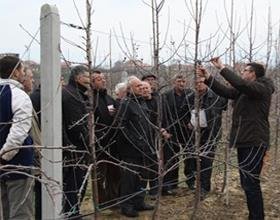
Pruning is one of the pomotechnical measures and is applied with the aim of achieving the objectives for which we cultivate the trees.
Reasonableness
- Shaping and maintenance of the tree crown from the seedling until the end of the life cycle)
- Maintaining the plant's vitality
- Improving the quality of flowering, fruiting, foliage, and crown
- Limiting growth
Basic knowledge about pruning
Understanding the main organs of the tree, especially the above-ground ones

A - Apple:
1 - nipple,
2 - woody branch,
3 - thin branch,
4 - short branch,
5 - thorn branch,
6 - 7 thin and short branches with a fruiting bud at the tipRoot collar – the connecting part between the root canal and the above-ground root
Trungu – the part from the root Q to the first branch, which can be long (60; 60-100; over 100 cm)
Central leader – the branched part of the tree from the trunk to the continuation of the central U.
The Central Leader's Successor – the part that leads the growth of Central West
Branches: Skeletal (primary, secondary, tertiary), Auricles (branches of the fourth order and onwards: short branches (3-6 cm, with an angle of 90°), thin branches (10-25 cm), torso branches (10-3 cm), thorn twigs (1-3 cm), woody branches (50-60 cm serve for crown formation), suckers (develop from dormant buds), bread-shaped shoots (3-6cm, have 4-7 fruit buds), They live up to 30 years) Bud – Vegetative (active, dormant, adventive) (apical, terminal), (woody, leafy), Generative (flower) (simple, compound)
Understanding development cycles
Life cycle – Embryonic phase (from flower fertilization to seed germination), Youth phase (vegetative), Maturity phase (fruit-bearing), Aging phase
Annual Cycle – Vegetation Phase and Mandatory Dormancy Phase
Crown shapes
Free power
Half-directed – improved pyramid, improved vase
Conducted – Pyramidal, vase, palm tree, pointed vines, spear and
throwing, vertical axis, ballerina, hajtek, V system, double javelin
etc.
Characteristics of the cultivars
Canadian Renetta – branches at angles 10° – 70° form fruit buds
Starcrison – branches at the 00° – 80° angle form fruit buds
Golden Delisheci – branches at the 30° – 120° angle form fruit buds
Gala – branches at the angle of 45° – 100° form fruit buds
Greny Smith – branches at the angle 70° – 180° form fruit buds
Knowing the timing of pruning
- Winter hazard
- Green Hazard
- Winter pruning
It is applied during the tree's natural dormancy period; it is best to apply it after the aeration period (when the tree is subjected to very low temperatures), February – March. Tools - appropriate and clean (disinfected from time to time with 90% alcohol).
Several types of pruning

- Creating the vision – cultivation system, shape, competition, lighting, flower loads
- Removal of diseased, infected, and broken parts
- One-year-old shoots are completely removed from the tree canopy or remain untouched, except when there is insufficient growth and we want to stimulate growth through pruning
- Old twigs or two-year-old shoots are thinned or cut off.
- The skeletal branches are maintained at a height that corresponds to the designed crown system by removing strong shoots from the tips of these branches (competitors or brooms)
- Rival branches and branches to the central leader are shortened in the corner
- Ringing the bare parts of the central leader onto dormant buds or poorly developed branches (March – May)
- Removal of cut parts from the orchard
Green pruning and other comprehensive measuresduring the growing season
It is applied with the aim of balancing the vegetative and fruit-bearing parts of the tree, complementing winter pruning, the effects of which are: better illumination of the crown and fruits, elimination of competitors, rational use of food, stimulation of the formation of fruit buds and productive branches for the following year, removal of infected or damaged parts, improvement of fruit quality (color, fruit size, nutrient content), and reduces yield compared to winter pruning, which increases the tree's abundance. Trees with low fruiting do not need pruning during the summer.
The time when green pruning and other supplementary measures in the crown are applied the most is from mid-May until the end of June. However, these measures are also applied in the later stages of vegetation depending on the needs and age of the tree (crown shaping, removal of infected parts).
Actions undertaken during green pruning and other measures
The following are supplementary:
- Removal of certain unnecessary vegetative parts
- the curvature
- Fruit thinning
Removal of certain unnecessary vegetative parts from the tree
- Thinning (forgetting) of shoots (non-woody vegetative growth) that do not have a good position on the tree
- Early stage removal of shoots at a length of 25 - 30 cm (in the form of suckers, with a rough angle)
- Can be removed by breaking from the base
- By shortening to a length of 1 cm from the base above the two weak lower leaves
- Isolation of the central leader (removal of 2-3 shoots under the continuation of the central leader)
- Branches cut during winter pruning produce 2-3 shoots, of which only one should remain.
- Pinching and pruning certain shoots for the purpose of
- limiting growth, favoring or encouraging the formation of other early lateral shoots with fruit-bearing prospects
- Removal of infected parts


Available in: SHQ, ENG, SRB