

In circulation is: Dried flower heads
It originates from the Mediterranean and was also used in ancient times by ancient peoples as a medicinal plant.
Morphological and physiological characteristics
It is an annual plant, rarely 2 years old. The cultivated plants reach a height of 60-80 cm. They have axial roots with straight stems, while the upper part is branched. Flowers are found at the tips of the branches. Calendula blooms from June until the appearance of frosts.
Chemical composition and use of the calendula plant
Dried calendula flowers contain 0.02% essential oils and % fatty oils, sugars, etc. It is used more in traditional medicine than in scientific medicine. In folk medicine, it is used for wound healing and for the benefit of various teas against urination. From the flowers, an extract is extracted which is used to reduce cholesterol levels in the blood, etc.
Conditions for success
Climate - It thrives in various climatic conditions but thrives most in hot and humid climates.
Soil - It should be cultivated in soils with good physicochemical characteristics. It does not tolerate heavy, wet, or poor soils.
Cultivationof
Crop rotation - It must definitely be cultivated in crop rotation because it is an annual crop. The most suitable pre-crops are legumes, millet crops, and cereals.
Basic soil cultivation - Done in autumn, while surface tillage in spring shortly before planting.
Fertilization - with barn manure and other organic fertilizers.
Propagation - In the kitchen garden production, it is cultivated with seedlings, while in large-scale production it is propagated by seed.
Sowing - Done by machine, planted in rows 50-60 cm apart, seed sowing depth 3 cm, sowing is done at the end of March or beginning of April. 6-8 kg of seed per hectare is needed, while the first sprouts appear 15 days after sowing.
Care
As with other perennial plants, cultivation must be carried out between rows, feeding, and irrigation. Weeding must be regular throughout the entire growing season to keep the soil loose and to remove weeds. The first mowing is done after marking the rows, and the others as needed.
Irrigation – should only be used if there is drought for a long period. Watering in July and narrowly prolongs the flowering period.
Harvesting - It should begin when the plants have a sufficient number of flowers for picking. Flowering begins at the beginning of June, while harvesting starts at the end of June and continues until the appearance of frosts.
Drying - Flowers can be dried naturally or with dryers. Under natural conditions, they should be dried in a thin layer and in areas exposed to air drafts. They are dried in dryers at temperatures up to 50°C. The ratio is 5-6 kg of fresh water per 1 kg of drying.
The yield of calendula is 1,000-2,000 kg of dried flowers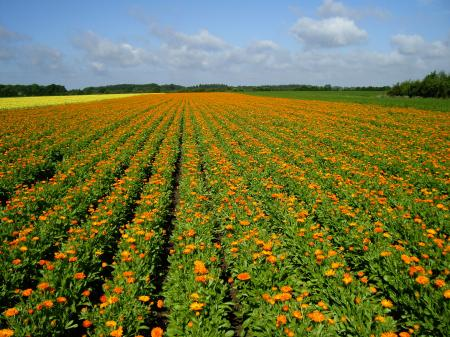
Kalendula – Calendula officinalis L.
Available in: SHQ, ENG, SRB