
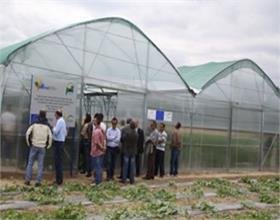
Due to strong solar radiation during the summer months, especially in July and August, there are significant problems in the normal development of plants in greenhouses because there is a significant rise in air temperature, as well as fruit and vegetable burns and uneven coloring. One way to lower the temperature inside the greenhouse is to ventilate the greenhouses, specifically by opening windows for ventilation, which replaces the air inside the greenhouse with the air outside it. Often during these two months, very high outdoor air temperatures and strong solar radiation reduce the effectiveness of greenhouse ventilation in lowering the temperature and protecting the fruits from strong solar radiation.
In order to protect vegetable fruits from strong solar radiation and to lower the temperature in the greenhouse, it is preferable to shading the greenhouses during periods of very warm weather. A decrease in the amount of solar radiation is associated with a decrease in the energy accumulated in the greenhouse. Shading greenhouses is one of the most common ways to reduce solar radiation in a greenhouse, but since light is essential for plant photosynthesis, the amount of plant shading has a certain limit. In cases of prolonged cloudiness, shading becomes a problem for the normal growth of plants, but nevertheless, it remains one of the main tools for lowering greenhouse temperatures in summer. The positive effects of shading on air temperature, plant leaf temperature, and the reduction of solar radiation intensity inside the greenhouse are presented in the following table.
|
Greenhouse type |
Air temperature 0C |
Leaf temperature 0C |
Intense luxury lighting |
|
An unshaded greenhouse |
36 |
40.3 |
70200 |
|
Shaded Greenhouse |
32 |
31.6 |
27000 |
There are many methods and materials used for shading. The simplest method is to paint the outer surfaces of the greenhouse covers with lime, clay, flour, etc., or paints prepared by the industry for this purpose. A problem in such cases is the lack of uniformity in the lighting in the greenhouse and the inability to adjust the shading intensity according to meteorological conditions.
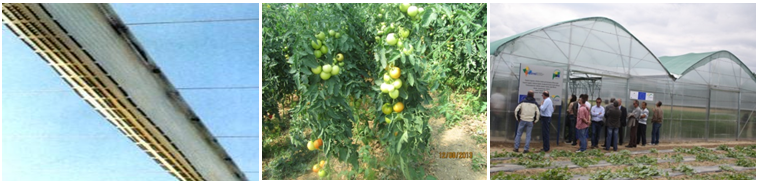
The best alternatives for shading protected environments are plastic shading nets and thermal screens. The former are composed of plastic fibers woven at a certain density, which determines the intensity of the shading. The placement of the nets is usually done on the surface of protected environments and in terms of operation can be static (moved over relatively long time intervals) or movable (their position can be adjusted whenever necessary with simple manual or electrical systems).
The most advanced shading systems are the so-called "thermal screens." Thermal screens are composed of synthetic fibers intertwined with thin aluminum strips. Depending on the density of these strips, the intensity of shading in the greenhouse is determined. Thermal screens are installed on the greenhouse ceiling and are generally automated. Their movements and sizes are adjusted according to the intensity of radiation and the characteristics of the plants grown in the greenhouse. The function of the screens is twofold; reducing the intensity of solar radiation inside the greenhouse in hot weather and decreasing energy losses from the greenhouse at night, in cold weather, and with frost.
Available in: SHQ, ENG, SRB