
What is ectima?
Ecthyma is a contagious skin disease of sheep and goats, which mainly affects young animals during their first year of life.
Who causes sheep's ectima?
The cause of the disease is a virus that belongs to Poxivirus, the family of parapoxif viruses.
The ecthymia virus primarily affects the skin around the mouth; however, the injuries/wounds can become widespread and spread to other parts of the body, and it can also be transmitted to the milk glands of sheep and goats. Wounds in the mammary gland can cause acute mastitis with staphylococcus in sheep/goats and failure to feed lambs. Furthermore, hungry lambs can spread the disease to other sheep when they try to "steal the milk"
Affected young lambs may be unable to feed for several days, becoming weak, emaciated, and prone to secondary bacterial wound infections, which can lead to prolonged illness and, in the worst case, even death.
The ecthymia virus primarily affects the skin around the mouth; however, the injuries/wounds can become widespread and spread to other parts of the body, and it can also be transmitted to the milk glands of sheep and goats. Wounds in the mammary gland can cause acute mastitis with staphylococcus in sheep/goats and failure to feed lambs. Furthermore, hungry lambs can spread the disease to other sheep when they try to "steal the milk"
Affected young lambs may be unable to feed for several days, becoming weak, emaciated, and prone to secondary bacterial wound infections, which can lead to prolonged illness and, in the worst case, even death.
How does the ectyma virus spread?
The virus can spread from infected animals through direct contact with other animals showing signs of the disease. Also, the ecthymic virus can be transmitted through contact with tools, food, and bedding that has been in contact with infected animals. The virus seeks skin damage to enter and produce the infection.
Outbreaks can become especially severe in sheep/goats on farms due to the large number of livestock found in one place. Outbreaks last between 6 and 8 weeks. The virus can remain alive in cold and humid environments for years. Therefore, it can survive in buildings for many years. Sheep/goats that have had this disease have limited protection against repeated infection, but subsequent infections are milder and have a shorter lifespan than the initial infections.
Outbreaks can become especially severe in sheep/goats on farms due to the large number of livestock found in one place. Outbreaks last between 6 and 8 weeks. The virus can remain alive in cold and humid environments for years. Therefore, it can survive in buildings for many years. Sheep/goats that have had this disease have limited protection against repeated infection, but subsequent infections are milder and have a shorter lifespan than the initial infections.
Signs of Ectima?
The disease spreads very quickly, and up to 90% of the herd can be infected within two months. Both sexes and breeds of sheep/goats are susceptible to this disease. The infection sites are generally the lips and nose, but the mammary glands and the lower parts of the feet can also be infected.
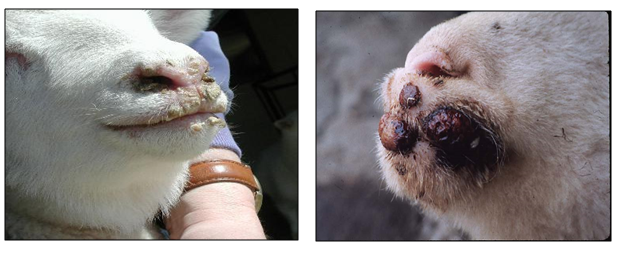
Fig. 3 Sheep with contagious ectation
Human infections with the Etyma virus?
The virus spreads to humans through contact with infected sheep. The infection is usually seen on the hands or face.
Treatment of Ecthyma? Treatment of infection in infected herds is limited. Improvement can occur faster if infected animals are treated individually locally on the skin. A 50% iodine and glycerin 50% solution applied to affected areas with a soft brush is believed to be helpful. This treatment should be applied daily. Gloves should be used when treating infected sheep to prevent transmission to humans.
Prevention of Ectima?
Ectyma testing in sheep/goats should include general cleaning, accompanied by disinfection of the environment and tools in contact with infected animals. The number of sheep/goats in the barn should be according to the prescribed conditions. Where possible, infected sheep/goats should be separated from the affected animals. Sheep/goats should not be vaccinated against ectyma unless there are problems with this disease. Chronically ill animals should be removed from the herd.
There are vaccines against this disease (Scabivax, Vaxorf, etc.). Since the vaccine is made from live virus, gloves must always be used when administering the vaccine, as infection of people can occur. The vaccine can be given after 1 week of life and should be repeated after 2-3 weeks.
There are vaccines against this disease (Scabivax, Vaxorf, etc.). Since the vaccine is made from live virus, gloves must always be used when administering the vaccine, as infection of people can occur. The vaccine can be given after 1 week of life and should be repeated after 2-3 weeks.
Share
Available in: SHQ, ENG, SRB