
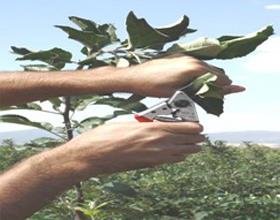
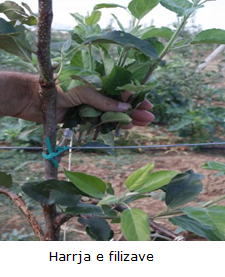
It is applied with the aim of balancing the vegetative and fruit-bearing parts of the tree, complementing winter pruning, the effects of which are: better illumination of the crown and fruits, elimination of competitors and rational use of food, stimulation of the formation of fruit buds and productive branches for the following year, removal of infected or damaged parts, improvement of fruit quality (color, fruit size, nutrient content), and reduces yield compared to winter pruning, which increases the tree's abundance. Trees with low vigor should not be pruned during the summer.
The period when green pruning and other supplementary measures in the crown are applied the most is from mid-May until the end of June. However, these measures are also applied in later growing seasons depending on the needs and age of the tree (crown shaping, removal of infected parts).
The actions taken during green pruning and other supplementary measures are:
• Removal of certain unnecessary vegetative parts
• Curvature
• Fruit thinning
Removal of certain unnecessary vegetative parts from the tree
• Thinning (forgetting) of shoots (non-woody vegetative growth) that do not have a good position on the tree
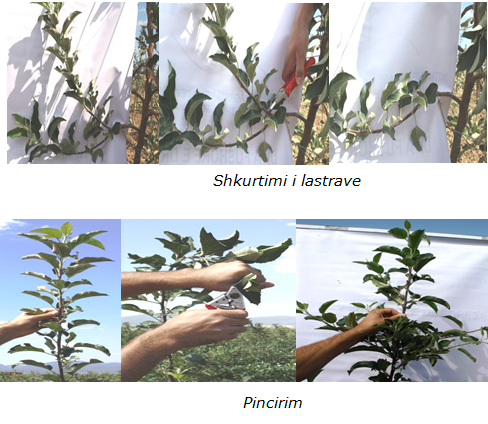
• Early stage removal of shoots at a length of 25 - 30 cm (in the form of suckers, with a rough angle)
• Can be removed by breaking from the base
• By shortening to a length of 1 cm from the base above the two weak lower leaves
• Isolation of the central leader (removal of 2-3 shoots under the successor of the central leader)
• Branches cut during winter pruning produce 2-3 shoots, of which only one should remain
• Pinching and shortening certain shoots with the aim of limiting growth, favoring, or encouraging the formation of other premature lateral shoots with fruit-bearing prospects
• Removal of infected parts
the curvature
Bending is a very important measure in the formation of the tree crown and is applied from the first year until the crown formation in the fourth year. This measure is applied from the end of April and depending on the development of the branches, it can be applied until August or even September
• Bending through various weights such as concrete, sand, etc. (applied to woody shoots by placing them at a specific point on the shoot to achieve an optimal bend of 70-90 degrees)
• Bending through the tooth recesses (applied when the base of the shoot begins to become woody and reaches a length of 15-25 cm)
• Bending through rope – twine (applied to woody shoots at the stage when they are most elastic, where it is recommended to use ambient twine made from plant material that unravels after some time), it is a highly applicable and functional form in intensive production
• Bending through special plastic devices
• Bending through twisting (applied when there is very vigorous shoot growth (end of May, half of June))
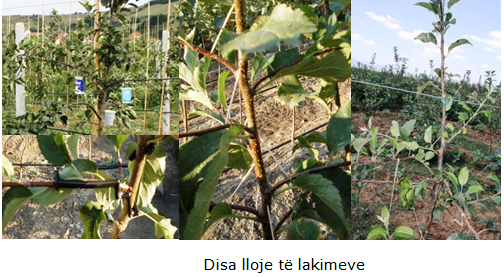
Fruit thinning
• The apple has the capacity to produce more fruit than necessary
• Thinning is necessary
• Fruits are thinned by spraying applied 1-2 weeks after flowering (Sevin, NAA) and by hand when they reach the diameter of a finger, but flowers can also be thinned using special thinning machines
• On average, it is sufficient to leave the fruits at a distance of 15cm along the branch, while a flower should have only 1 fruit, at most 2 fruits
• Most fruit buds are initiated 4-6 weeks after flowering; late thinning does not help in initiating fruit buds, and alternative fruiting often occurs
Share
Available in: SHQ, ENG, SRB